the bead cabinet grows up

“The child gives us a beautiful lesson – that in order to form and maintain our intelligence, we must use our hands.”  – Maria Montessori

The beauty and efficacy of Montessori pedagogical materials is well-established. Designed specifically for the developmental stage of the children in a given classroom, they meet a child where they are in the moment. There are a handful of Montessori materials, however, that follow the child from one classroom level to the next. Their presentation to children, as they age, grows in complexity and deeper in understanding.  One such material that finds a home both in Primary and Elementary classrooms is the Bead Cabinet, that big and beautiful collection of squaring (short) chains and cubing (long) chains from one to ten. Many fused squares and a single fused cube for each number is also displayed.  An emphasis on counting was present in those younger environments, but this would surely be “baby stuff” to a six-year old. Instead, our work in the Elementary years, the Second Plane of Development, will range from seeing patterns, skip counting, multiplication tables, and a nascent understanding of squaring and cubing.

The colorful array of linked chains, squaring chains arranged on horizontal shelves that gain in length from one to ten, and cubing chains hanging vertically, are all presented similarly. Each chain, each number, has a corresponding box of arrow labels, in that chain’s color, that always include the cardinal numbers up to that number and then its multiples. The box that accompanies the squaring four-chain for example, contains the labels 1, 2, 3, 4, 8, 12, and 16. The last label arrow in a series is wider, to denote that it is the square of that number. The cubing chain has a matching color box with cardinal numbers, wider arrows for the squares it contains, and the widest of them all, the mother of all labels if you will, is the cube. The arrows contained in the light blue cubing box to match the five-chain for example, will have 1, 2, 3, 4, 5, 10, 15, 20, 25 (wider arrow), 30, 35, etc… ending with the widest arrow for 125. The arrows for 50, 75, and 100 are wide, and children will often place a fused square above each of these arrows, placing the cube at the very end.

The work is somewhat intuitive. The child lays out a given chain (while there is no set sequence, squaring chains precede cubing chains; the one and two chains are actually a bit trickier!). Once the chain is completed, the child recites the multiples, skip-counting to the end of the chain. Some classrooms have children write these as multiplication tables, while others have pre-printed recording sheets. Once laid out, there are a myriad of possibilities that two or three children can investigate, all in service of memorization. Children can recite the multiples progressively and then regressively. The first child flips an arrow over and another child has to name the missing multiple. Every other arrow can be flipped over and the children recite the missing multiples. Eventually all the arrows are flipped or removed, and the child(ren) skip count the multiples.

As is usually the case, the ten chain, which has one hundred beads, gets special treatment. Lay the squaring chain of 100 on the rug. Ask the child if they can fold it into a square. Superimpose the hundred square on top to show equality. Ten taken ten times is one hundred. Unfold the chain. Lay out the green unit arrows and have the child place them under the first nine beads. What comes next? The child places the 10 – 90 arrows appropriately. And finally? The large red 100 arrow. Have the children close their eyes while you remove an arrow. What’s missing? Everyone closes their eyes while a child removes an arrow. What’s missing? Later, Where is 37?  Where is 84?  Where is 61?  Or, someone (teacher or child) points to any one bead and everyone else names it. Note if a child can count backwards from 60 to get 59 as opposed to starting with 50. Skip count by tens backwards.

The cubing chain for ten often represents the final chain in the sequence, though this should not be misconstrued. The squaring and cubing chains should be done repeatedly, using the full complement of the work over and over. Carefully give a lesson on how to transport the thousand chain (it’s heavy!). Lay the long chain on a rug in ten parallel rows of ten ten-bars each, as it is when hanging. Cover with the 100 squares to show equality. Stack the 100 squares into a cube. Ten tens make one hundred, and ten hundreds make a thousand. Place the thousand cube next to the stack of hundred squares. How many beads does this chain have? One thousand! Let’s see what that looks like. Let’s carefully stretch this chain out.  Note: Some classrooms have super long and narrow rugs just for this purpose. Unfold the chain of 100 to compare. Count together from 1 – 9, then by tens to one hundred, laying arrows down as you go. When you get to one hundred, place the red 100 arrow, but also a hundred square next to it.  Continue counting with the children by 10’s to 200 One hundred ten, one hundred twenty, one hundred thirty…  Place the 200 arrow and a second hundred square. When you reach 1000, have the child place the largest arrow (green), a hundred square, and then the thousand cube. All the activities we employed with the chain of 100 can be used here.

As a teacher educator, if I have a group of thirty adult learners in an Upper Elementary course, and I’m covering squaring and cubing, the notation, the superscript 2 or 3, there is almost always two or three students who will come up to me during a break, and somewhat abashedly tell me that up until that day, they never understood why we called a number times itself  “squared” and when multiplied, “cubed”. There is no underestimating the lasting impact of using your hands to manipulate materials such as the bead cabinet, with engagement, over many years.
the constructor

Dr. Montessori often used the word, “costruire”, the translation from the Italian being “to build, create, to construct”. Before children can become Greeks (working abstractly), they must first be Egyptians (use their hands). One could write a treatise (or two!) on the myriad of ways a Montessori prepared environment provides opportunities for a child to construct, both physically, cognitively, and even as a metaphor for emotional and social growth. Specific to a manipulative material, the Geometric Cabinet can serve as an excellent model for the concept of construction.

The Geometric Cabinet is one of the more important and versatile geometry materials we have in our Montessori classroom. It is, or should be, present in every Early Childhood and Lower Elementary classroom, but it is also used (more likely borrowed) in many Upper Elementary environments as well. It is a beautiful material to display. The large wooden cabinet with six drawers brings attention to itself and adds to the impressive array of our Montessori environments.

Demonstration Tray

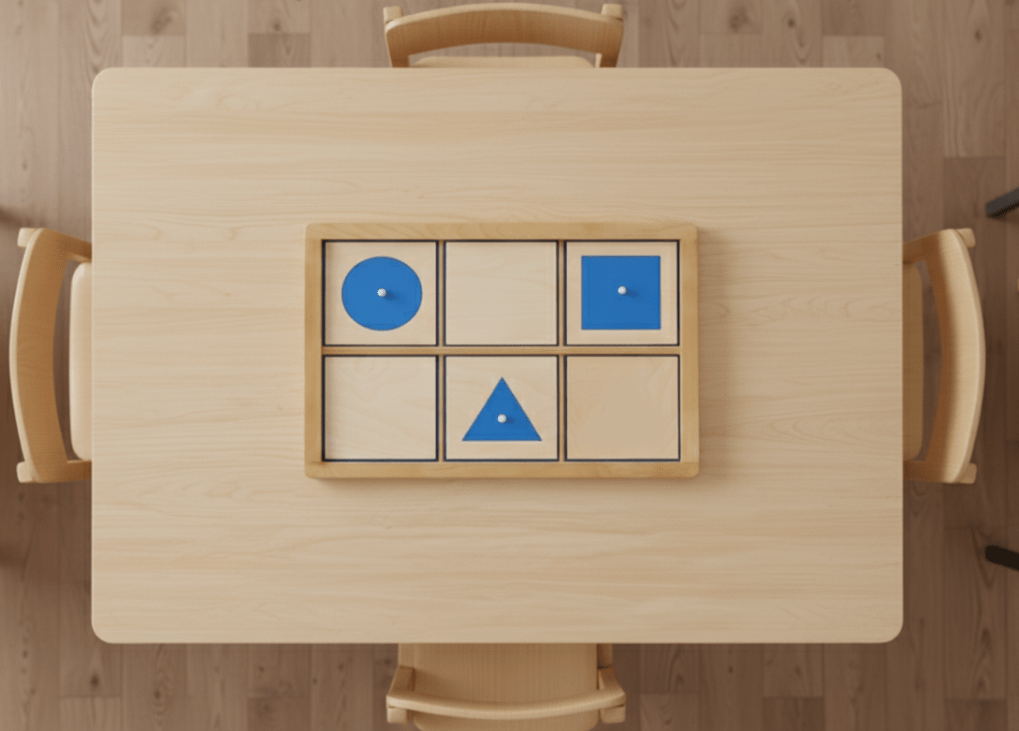
Traditionally, a “Demonstration Frame”, that sits on top of the cabinet, holds the Circle, Square, and an Equilateral Triangle. In some schools the order of the drawers differs from Early Childhood to Elementary environments. It is also important to note that there is no set of specific figures present in the cabinet. Certainly, there is always a Triangle Drawer, a Polygons drawer, a Rectangle drawer, and a Circle drawer. There is almost always a Quadrilateral drawer, but the sixth drawer can sometimes be Curved Figures, but a Miscellaneous Figures drawer is not uncommon!.

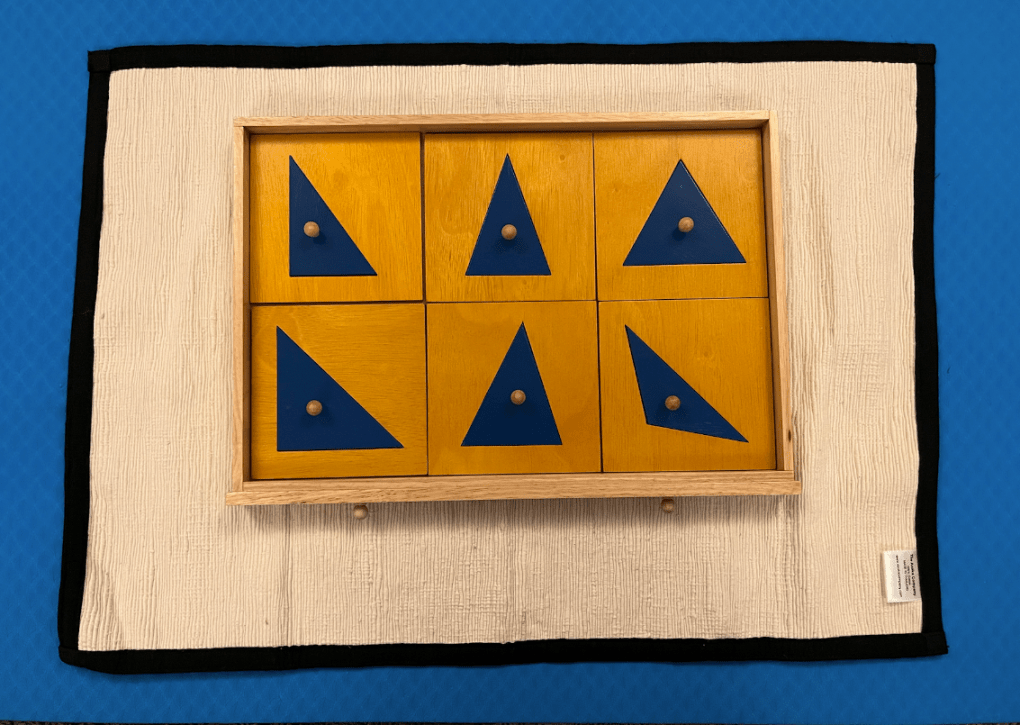
The first drawer displays triangles; acute-scalene, right scalene, obtuse-scalene, acute isosceles, right isosceles, and obtuse isosceles. The drawers present these shapes in two rows of three. How to order them? One suggestion would be the scalene, isosceles, and equilatreal across the top row to classify by sides  the bottom row to show examples by angle. Right-angled in the first column, obtuse-angled in the middle column, acute-angled in the right. We put those after the right as they are both determined by their relationship to a 90 degree angle.

The Geometric Cabinet

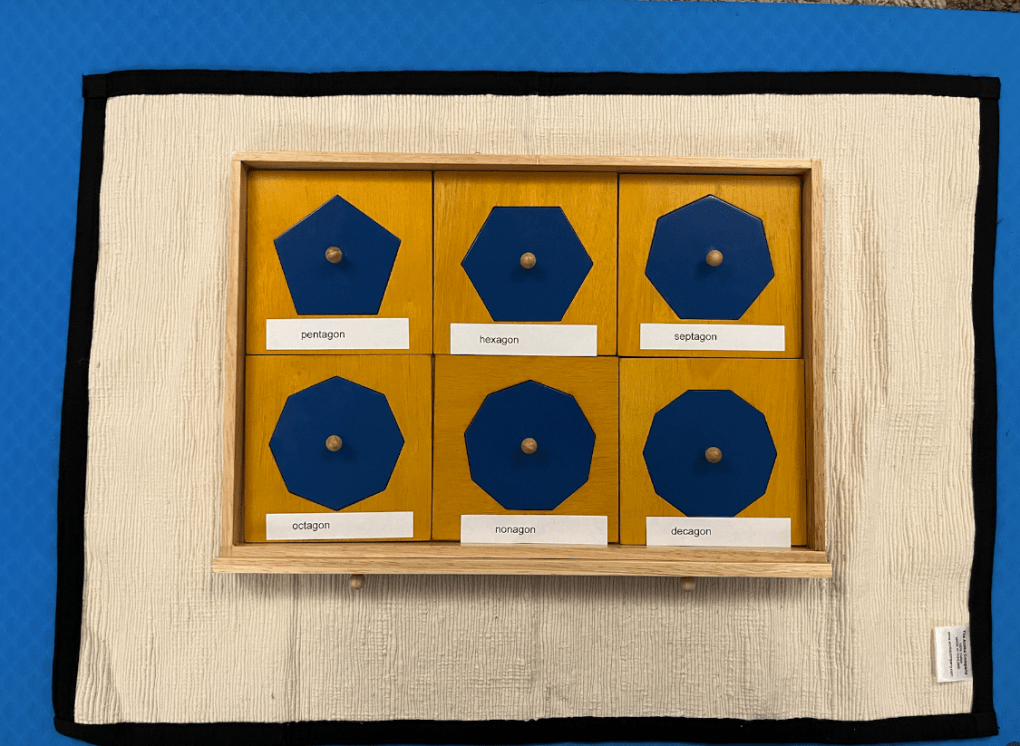
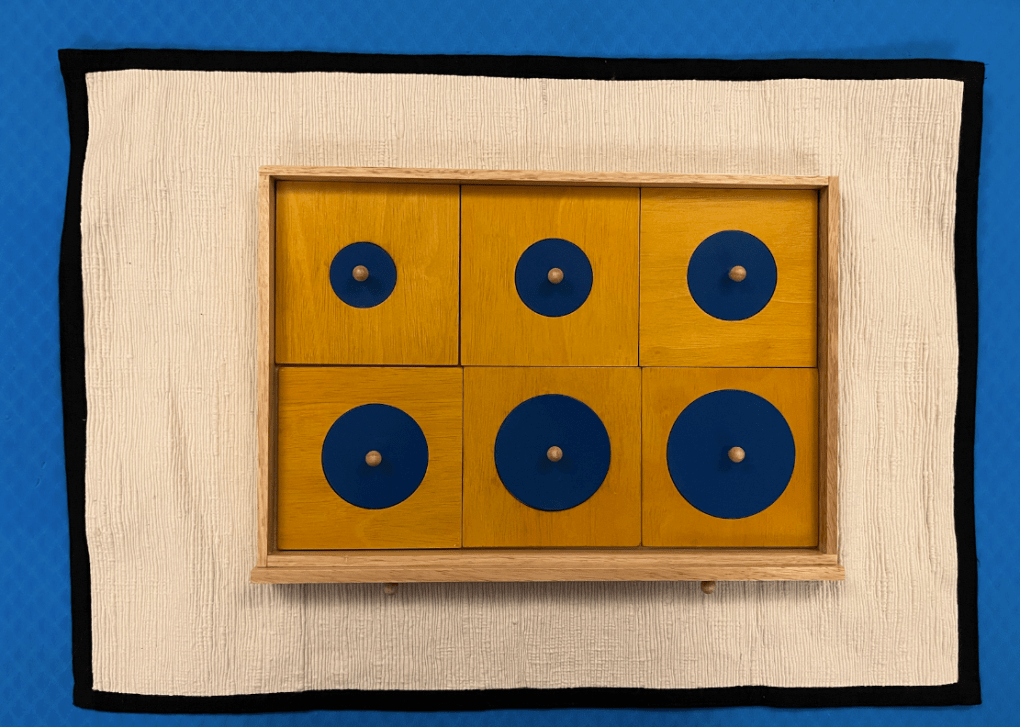
The second drawer displays quadrilaterals; trapezium (sometimes referred to as a common quadrilateral), parallelogram, trapezoid, and rhombus, The third drawer displays rectangles. There are six shapes total, five rectangles with gradually lengthening bases, and one square in the bottom right corner. The fourth drawer is a set of six regular polygons, and they are arranged by number of sides. The pentagon, hexagon, septagon make up the first row. Octagon, nonagon, and decagon round out the second row. The fifth drawer contains the circles. Again there are six, of different diameters starting in the top left (5cm) and ending in the bottom right (10cm). The 10cm circle matches the demonstration tray circle mentioned above. These drawers, with these figures, are common to every Geometric Cabinet.

The Geometric Cabinet

The Geometric Cabinet

A common, and desired sixth drawer contains curved figures. The oval and ellipse certainly, quatrefoils and a curviliinear triangle maybe. The curvilinear triangle can also be called a Rouleaux Triangle, named after Franz Reuleaux,a 19th-century German engineer who pioneered the study of machines for translating one type of motion into another, and who used Reuleaux triangles in his designs. As one could probably guess, the design itself predates him by centuries. Perhaps he had a better PR firm? The contents of some sixth drawers, as mentioned earlier, will use the drawer for miscellaneous figures, like the delta (kite) or a convex quadrilateral (boomerang).

The Cabinet is supported in both Early Childhood and Elementary classrooms with cards that match each figure. Typically the child starts with cards that are solid figures, then those with thick outlines, and finally a thin line outline. Labels for each figure can also be purchased or teacher-written. A companion material would ceratinly be the Constructive Triangles. It even has construct in its name, after all. It also represents a material that is presented not just in early childhood and lower elementary classrooms, but upper elementary as well.

toddlers and teens

When teacher-education is done right, a bond is formed between the presenter and the group of adult learners. If both parties are open, engaged, attentive, and respectful, the dialogues are more meaningful, the practice sessions are more energized, and it’s common for everyone to experience a “flow experience”, a concept developed by psychologist Mihaly Csikszentmihalyi, who studied how Montessori education can be structured to achieve it. I’ve found, in these decades of teacher-education, that the same is true for quality training course. “Where did the afternoon go?” This trusted relationship continues after the course is over, when these adult learners have questions once they are in their first months of teaching. If passion has been sparked and that flame nurtured, it remains. Last week, an email from Via, in Bandung, was in my inbox. What does it mean that the first stage of Montessori Development and the third stage are the same?

There are several similarities between children birth – 6 and 12 – 18.  First, consider that the child in the First Plane is orienting themselves to this new world and environment in which they find themselves. They are learning new skills, certainly, but also observe them cognizant of being an individual, identifying themselves as part of a family, defining their relationship with their caregivers, and discovering their role. They are, at birth, nascent human beings.  A teenager, on the cusp of puberty at the Third Plane of Development is also orienting themselves to a new world, the world and environment of adulthood. They are learning new skills, certainly, but they are now cognizant of becoming an adult, seeing their changing identification within their family, defining a new relationship with parents, thinking about who they are, what music they like, what books they enjoy, how they feel about larger societal issues.  They are, at 12 years old, nascent adults. 

How do we see these manifest in their behavior? There are similarities here as well, especially noticeable if you’ve had the opportunity to parent or teach children in both planes. Children in the first plane are highly egocentric; they are the center of their world. “What do I want right now?” “What do I need right now?”  The child in the third plane is similarly motivated. “Everyone will be staring at me” “No one understands me”.  Children in the first plane, especially in the second subplane, have a complex relationship with their caregivers. Observe the five-year old on the playground who runs to their father to get picked up only to immediately wiggle away to climb up the slide. Observe the 15 year old who wants to be independent. “Why can’t I go to the concert at the arena?  You never let me do anything, I’m suffocating in this house!” but the next minute wants to curl up on the couch with mom or dad and watch old cartoons.

What’s fascinating to consider is that Dr. Montessori made these assertions well before science and medicine had access to brain studies. And yet, we know now that the first and third planes are both times of tremendous brain and neural growth. It’s common knowledge that from birth to six is the greatest growth, but less so that the second period of greatest growth is from twelve to eighteen years of age. First and Third represent growth. Second and Fourth represent consolidation.