
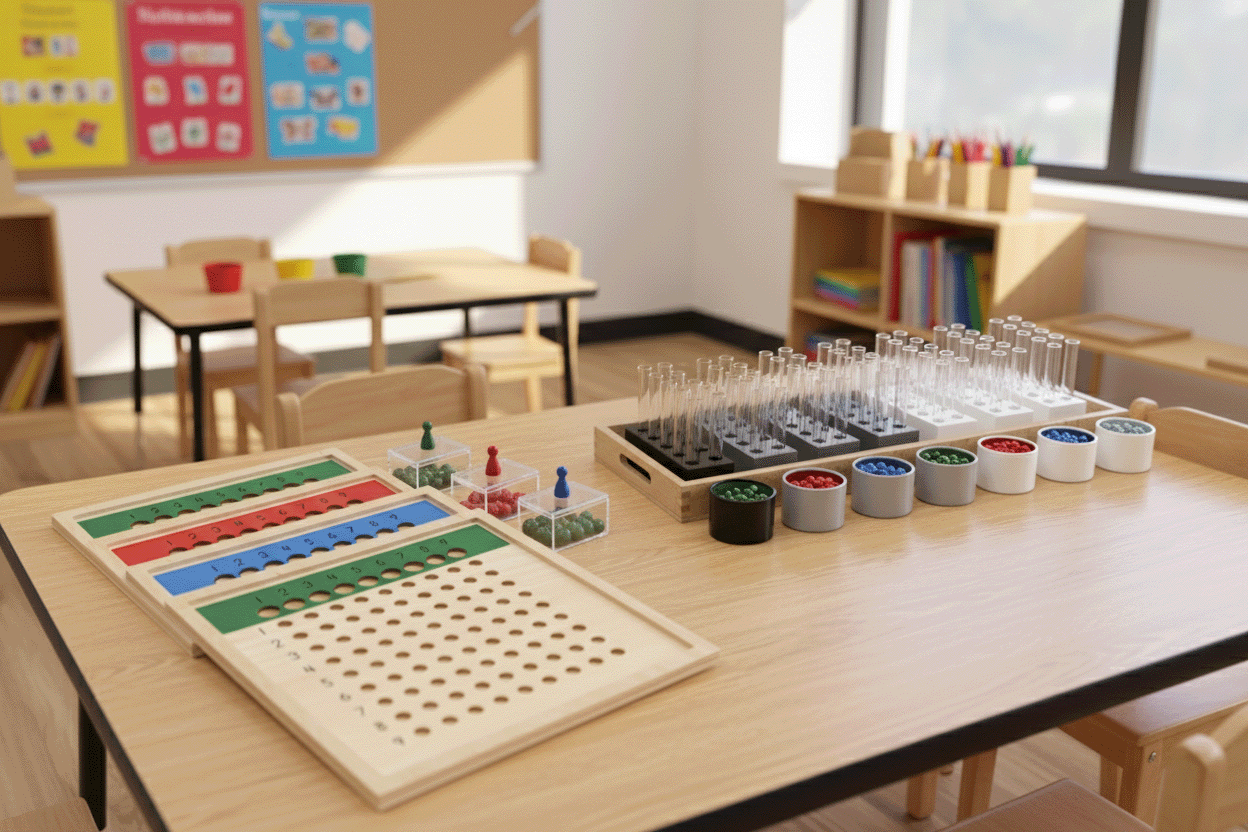
With the bead frames and checkerboard, the children were not able to carry out division. The concept of division was given with the decimal system material (golden beads), where they saw the beads distributed into equal parts. Then they saw it with the stamp game as both distributive and group division. The memorization materials worked parallel to these earlier lessons and were an important preparation for this later stage of work. Learning those combinations, as well as their multiplication facts will enable the child to carry out the division quickly.
With this new material, the Hierarchical Materials (nicknamed “Racks and Tubes” or “Test Tube Division”), the child can carry out problems with a dividend in the tens and hundreds of thousands, even millions.
The Stamp Game, Bead Frame, and Checkerboard, lead the child to abstraction in addition, subtraction, and multiplication, quite elegantly in fact. Division is different. The lessons presented with the decimal system (golden bead) and again with the stamp game used distributive division to find the answer, the quotient in a division problem. To divide abstractly, the child must learn group division. “You get one, you get one, you get one, you get another, you get another you get another…” results in the correct answer, but is a different skill from “How many of these are contained, go into, this?” To lead the child towards this abstraction, we will put special emphasis on the recording of our work.
The Hierarchical Material which consists of seven test tube racks: 3 white (containing green, red, blue beads), 3 gray (with green, red, blue beads), and one black (with green beads). Matching these are seven bowls with matching external colors: 3 white, 3 gray, one black, and internal colors: that are hierarchical, meaning the unit bowls are green, tens are blue, and hundreds are red. In each rack there are ten test tubes 10 beads in each tube, so lots and lots of beads! To perform the distribution, there are four boardsm each with 81 holes/ two green (units and units of thousand), one blue, one red. Finally, there is a box containing many green, and red skittles to represent our divisors
The first division done with the child may be relatively simple, although the material allows children to work with dividends in the millions. Some children will enjoy the challenge of starting with a seven digit dividend while others will find it overwhelming. Our first example is based on a dividend formed of at least two or three digits. The divisor is one digit. There should be no remainder in the initial presentations.
Start with the problem such as: 4)9764
The first time we will only write the quotient. In order to reduce confusion, we will remove from the tray only the necessary holders and bowls.
Form the number by putting the correct hierarchical beads into the bowls to form the dividend and place them closer to the child and to their right. Then put out 4 green skittles on the green board.


Bring the 1000’s bowl up to the bottom of the board and distribute them to the four skittles. We see we can give two to each. But we have one we are unable to distribute. Place it in the 100’s bowl. Write 2 (what each skittle received) above the 9 in the dividend. Pick up the green beads on the board and put them back in their test tubes, referred to as “clearing the board”. Turn the now empty thousands bowl over and slide off to the left of the child.
Look in the 100’s dish. There are 7 reds and 1 green. The green can’t stay so change it for 10 reds (a full tube). Then distribute the reds (100’s). We can give 4 to each skittle. Record a 4 in the hundreds place. We have one red we can’t distribute. Place it in the 10’s bowl. Then pick up and put away all the hundreds beads, turn the bowl over and slide off to the left.


Move the tens bowl up to the board. Look in the bowl; there are 6 blues and 1 red. Change the red for 10 blues. Distribute the tens. This time there are none remaining. Record a 4 in the tens place, pick up the beads and put away the tens bowl.
Move the units bowl up. There are 4 green unit beads to be distributed, and each skittle receives one. Record this final number in the quotient. A good note to keep as a reminder for this presentation is, “beads first, record quotient only”.

Children benefit from lots and lots of repetition at one level of complexity before moving on to the next. I would use the word “facility” meaning there is an ease and confidence in their working through the problem. Perhaps that’s difficult to define quantifiably, but as a parent/teacher, you’ll recognize it when you see it. When it does come time to move ahead, when the child is ready to move from this concrete experience to the next level, we’ll take a small step by simply recording our work, resulting in a problem on paper that will follow the same algorithm we all learned in our childhood classrooms. Here the reminder will be, “beads first, record all work”. To isolate the difficulty, which is a component of Montessori lessons, use the same problem a child has already completed. In repeating the problem above, 4)9764, the work with our hands will be exactly the same. We begin, distributing the nine thousand beads to the four skittles as before. Okay, what did we lay out? Two rows of 4, so 8 green beads. Let’s record that. Write a 2 above the 9, and write an 8 below the 9. We started with 9 and laid down 8 so we subtracted. 9 – 8 = 1. Do we have one green bead left? Yes.
Exchange the green bead for ten red hundreds, adding it to the 7 beads in the hundreds bowl. Repeat the process, dividing, recording the quotient (rows) multiplying the rows by divisor to determine how beads are laid out on the board (or skip count), subtract, bring down, wash, rinse, repeat.
As we move through the next series of presentations, with larger dividends and multi-digit divisors, we’ll move through this same sequence. Eventually, the child will do the writing first, and confirm with the beads. At that point, they will be very close to abstraction, calculating division problems without the material. Once you have crossed the river in a boat, you no longer have to carry it. For more innovative Montessori materials, make sure to regularly visit our website at www.alisonsmontessori.com.Rob Keys


 Follow the Child