happy new year!

As any self-respecting teacher will tell you, the REAL beginning of the new year happens in September, not in January. We generally don’t stay up past midnight the evening before the first day of school and the drinking is usually postponed until AFTER the first week of school is completed. After the first day, maybe? In any case, January 1st seems arbitrary in education. If anything, for me at least, it marks a halfway point of the year, even though I’m sure that’s not arithmetically accurate. And I don’t even stay up late on New Year’s Eve.

True confession. I’ve always disliked the first days of school, and that’s true from my years as a Lower Elementary teacher, Upper Elementary teacher, and now in the Junior Class (or Lower Secondary as I’m hearing more and more). There’s that awkwardness of learning new names and new protocols, new bedtimes and new wake-up times. The routine of meals is disrupted and so hunger rears up at 10:30a in the morning. I’m of course speaking of the adult’s transition, but we can obviously say the same for our students. With older students, the first couple of days also feels like a data dump, there’s so much information to get across. I’m much more content once we’ve gotten into the flow of the year. I’ve spun a plate on a stick and have handed it off to children to find engagement. Here’s Geometry! Here’s a Stamp Game! Here’s Biology! It’s difficult for a classroom to become “normalized” when there’s been no “normal” for three months.

And so, the first weeks for me was always what I called “Academic Triage”.  You know how at an accident scene (I know, I know, bear with this metaphor a bit.  I’m NOT describing classrooms as accident scenes) doctors and nurses will examine each person and put them in different categories?  That’s sort of  a good strategy for those first weeks.  Get a math sample, a reading sample, a writing sample.  If you have kids coming from the Primary program, give them a few addition and subtraction problems to work out on the stamp game.  If you have kids that have been in Elementary classrooms, and they recognize a Montessori material, see what they can do.  What you’re looking to find here is groups that can work together.  Do you have two or three students that have a facility with math (or reading  or writing)?  How many groups do you have?  A group of eleven six-year olds may have three distinct math groups:  Group One: Can add and subtract without materials and are dividing with the stamp game, using the multiplication boards to memorize facts. Group Two: Adding and subtracting and dividing with stamp game, positive snake game, using the strip boards.  Group Three:  What’s Addition?

Happy New Year!

I feel your pain

North of Portland, Maine, where the coastline heads due East, the land is streaked with rivers and inlets that look like rain running down the side of a car window they are that many, they are that varied. One such rivulet, the Sheepscot River runs up to Wiscassett and under the Route One bridge that connects the town to Davis Island and eventually the Atlantic Ocean. I am here with family and extended family because Wiscassett is a convenient way station to Boothbay Harbor, Cabbage Island, and a lobster bake that has become a summer tradition. One of the many topics over pizza last night, from Burano’s in Bath, was bee stings, namely how old were you when you received that first pain, the circumstances, the reaction, both physical and emotional. The range, by the way, was anywhere from 4 to 40. There were no anaphylactic shocks at the table, but one case of hives that brought some deliberation of whether it was chemical or psychosomatic in nature. I was the “late to the sting game” party of the group, and told everyone that the worst experience I ever had with a bee sting was one that didn’t actually happen to me, but to my daughter, Amarinda, on her fifth birthday. She and I were at a playground in Hanover, Massachusetts, outside one of my childhood schools, while Sandi decorated the house with streamers and a vinyl Happy Birthday sign that was one of our traditions. The large wooden structure, bridges, towers and turrets which Amee clambored upon was home to at least one bee, and we had barely established the protocol for a first game when she shouted in pain, ran to me, and melted in tears and fears and confusion. Her index finger was bright red and a bit swollen, stung for sure, but not too badly. As a relatively new dad, I was outraged at the entire apian species, pollinators of the world be damned, but mostly I remember my own heartbreak and helplessness and the knowledge that I could not stand in between the world, its inherent pain and near-constant threat and my beautiful child, my children.

This morning, the dawn run did not yield the spectacular sunrise I was hoping to see. Only fog crowded the streets of Wiscasset as the tourists would in a few hours, here for another day of antiques and bookstores and ice cream shops and lobster rolls and shops that sell, amongst the embroidered pillows and candles and greeting cards, something called “lifestyle”. The run had other rewards. The sun was but an eraser smudge of white light, but the waters were calm below the bridge and it seemed that every passing minute a new boat would appear first as a wraith and emerge corporeal within a few strides. The headland to the north was belted with cloud, giving it the appearance of a top half hovering over its base. Runs, walks, or any times of alone are given to reflection and mediation. I thought of the day ahead and the evening last, the slices and salad and company around the back deck table. I thought of bee stings. I thought of children and I thought of parents. Amarinda is nearly six months pregnant, giving birth to her first child at 31, the same age I was at her birth. She will experience the same impotence of parenting and the dichotomy of both wanting your child to be protected from the many stings that will come from people and circumstances far more powerful than a small fuzzy bee and at the same time develop a resiliency and the ability to overcome. Parents can’t have it both ways.

Empathy has more depth than sympathy, or so we’re told. Our ability to support a friend through a divorce is limited when we are happily married. We’re in it, but not of it. It occurred to me this morning, halfway back across the bridge, that parenting is just a lifelong exercise in empathy. Elijah is content or proud or joyous and there’s a commensurate elation that wells inside of me. Amarinda moves from adulthood to parenthood and that transition resonates in my heart, an echo, a deja vu. The bee stings are, gratefully, few and far between these days, really these decades. That brings me peace. The stings will come, but so will the honey.

montessori in the time of covid

These are the days where we really notice the stretching of daylight, an incremental increase in minutes between sunrise and sunset.  Isn’t it lovely to both go about our day and return to our homes without necessarily needing to have the headlights on?

In independent schools, this also presages the cycle of enrollment, as prospective families look ahead to September, and make plans and hopes for their children’s education.  One of the themes that I have been hearing lately from applicant parents is one of “creative resiliency”.  If the last two years have been a collection of teachable moments, one of those lessons is certainly the importance of flexibility and the ability to overcome obstacles.  I believe these qualities, while always important in a child’s education, are more on the radar for parents these days.  “I feel I want my child to be in an environment that is especially suited to a more open-ended approach to a task.”, a parent recently told me after a tour.  “Our daughter would benefit from a classroom where they can take risks, possibly fail, but then persevere through their own efforts”, wrote another.  “I want to be courageous, and give my child something better than I received”, said today’s visiting dad.

Montessori schools are uniquely positioned to respond in these times, to this challenge, for these aspirations.  In our prepared environments manipulative materials and presentations are meant to be more open-ended than closed, the activities utilizing tools to be used to abstract concepts from concrete experiences.  Children live the idea of adapting their independent work time to accommodate their needs and the needs of their peers. Students discover for themselves their errors and how to correct them, leading to a self-esteem and feeling of accomplishment that cannot be found with a participation trophy.

This is not new. It’s what Montessori has been providing for well over a hundred years.  The pedagogy just seems to calling to families in a way that somehow feels more urgent and important.

from the concrete to the abstract, part two

In this way, in these years, the child develops the mental facility and imagination to see a digit as the quantity it represents. This growth continues as children move into the Upper Elementary environment. In Upper Elementary classrooms, we can see this evolve both in the use of the materials and in the curriculum itself. For instance, many of the math materials, e.g., the Checkerboard for multiplication and the Racks and Tubes for division, are designed to allow children to move from calculation using beads and bead bars to calculation done abstractly, using only pencil and paper. The repetition of process leads to memorization of algorithm. Other math materials allow the child to see difficult concepts, such as operations with fractions, percentages, geometry proofs, and the squaring of a binomial, as physical manifestations, making the abstract more understandable. That is, Montessori children can quite literally grasp the meaning of the math while wrapping their heads around the abstract concept being presented. And while math is a convenient and straightforward example of this process, it is by no means the only area of the curriculum that uses this structure. The study of grammar and sentence analysis at the Upper Elementary level, by its nature an abstract topic, is tethered to earlier concrete experiences, making the step away from the manipulative materials just that, a step. And a small one at that.

  In a larger sense, the Upper Elementary child is also developing the ability to think more abstractly in terms of time. Whereas for a younger child each moment is either “now” or “not now,” the older elementary child can think beyond the here and now to other lands and cultures existing across time. Further, Upper Elementary students can use this nascent imagination to see how their own lives perhaps would have unfolded across time and space. The curriculum responds in kind. History, geography, and science, known collectively as the cultural subjects (in the Montessori vernacular), have the study of ancient civilizations as a concentration. The 9- to 12-year-old child “takes these seeds of culture and germinates them under the heated flame of imagination.” Leaving Upper Elementary marks the end of the second plane of development (6 to 12 years old). The child moves into the Junior Class, i.e., the third plane or early adolescence, and the concomitant development from concrete to abstract continues in new ways.

The entire pedagogy, encompassing children of 2 1/2 to 14 years of age, reflects the development in each child. A toddler enters a Montessori community, touching, stacking, and mouthing his or her way through the environment. Some dozen years later, the student graduates, but now postulating, considering, and coming to conclusions about the universe. Toddler to Junior: the former manipulates the physical, real, concrete environment, the latter the mental, psychic, abstract environment.

  This transformative process also takes place within each plane of development. Smaller-scale evolutions from the concrete to the abstract in Toddler, Primary, and Elementary classrooms provide key manipulative materials at each juncture, matching the child’s development with each step taken forward. The materials themselves do not teach. Rather, they provide a vehicle for children to make their own discoveries, create their own “a-ha” moments, and learn for themselves. The third plane of development, from 12 to 18 years of age (the first plane was birth to 6 years, and the second  was 6 to 12 years), marks the start of adolescence. But even in these years of young adulthood we see the same change from concrete to abstract thought; it can be seen in several areas of the curriculum, but notably in the subjects of the humanities. The study of Shakespeare is often one of the stronger components of a Junior Class curriculum. As new readers to these classic plays, 13-year-olds are challenged by the vocabulary, often struggle with the meter, and take the histories, comedies, and tragedies at face value. The play is the plot, and the characters represent themselves. Under the guidance of a gifted teacher, these young adults begin to see the action as metaphorical, the plays as allegorical, the plots as representative of larger, more abstract concepts. Macbeth is more than a Scottish king, he is any power-hungry politician. Prospero is any puppet master adult. Iago is evil.

  This harmony of purpose, providing the developmentally appropriate concrete materials to allow the child to internalize a great body of knowledge as the mode of thinking becomes more abstract, is a profound characteristic of a Montessori education. 

from the concrete to the abstract, part one

An overarching theme of movement from the concrete to the abstract in a Montessori pedagogy can be discovered at each level. At the Primary level (3- to 6-year-olds), this can be seen reflected in the environment itself. Primary rooms contain three distinct areas: the sensorial, practical life, and academic areas, the latter of which is itself composed of arithmetic, geometry, language, and cultural areas. While these learning opportunities are available to all the children, they tend to have a particular developmental appeal and are selected by the students accordingly. For instance, a 3-year-old, who is likely a more concrete thinker, will be drawn more intently towards the sensorial materials. The Pink Tower, the Red Rods, the Broad Stair, and the Sound Cylinders are just a few of the many materials and activities that allow children to learn for themselves the distinctions between dimension and form, i.e., size and shape. Likewise, the practical life area, with its pouring works, polishing activities, and buttoning and zippering frames, also calls to a developmentally younger student. As the child matures, his or her attention is drawn to more challenging, more abstract, and more conceptual learning. In the Primary environment, this translates to the areas of language, arithmetic, geometry, and the cultural subjects (biology, geography, and history). 

  The advantages of a multiage classroom are manifold. An environment that encompasses learning materials ranging from the concrete to the abstract, and available to children over a 3-year age span, allows them to be successful where they are developmentally, regardless of their chronological age. This is not to say that a 5-year-old never uses the Lacing Frame, but one can speculate that for a 3-year-old it is a work of great concentration, while the 5-year-old uses it to take a mental break. And while the different areas of a Primary classroom are separated spatially, it is important that they are well integrated with each other. For example, the sensorial area serves as an indirect preparation for math, while the practical life area guides the child’s fine motor skills towards the development of writing skills.

At the Lower Elementary level, this development can be understood most clearly if we discuss the scope and sequence of the arithmetic curriculum. The Lower Elementary arithmetic curriculum includes, among many other concepts, computation in whole numbers, using all four operations. As they enter the environment, children are, by and large, in the nascent stages of “formal” computation. By the end of this 3-year cycle, many, though certainly not all, will gain a facility with math facts and will be able to add, subtract, multiply, and divide abstractly, to some extent, using just pencil and paper and no materials. This example represents a remarkable academic, psychological, and spiritual journey taken within each student. 

Through the use of manipulative materials, the child constructs an understanding of concept and a memorization of computation that eventually lead to abstraction. When we explore the materials and activities, it becomes obvious how they lead the child from stage to stage. Let’s look only at addition and allow this specific study to serve as a microcosm of the whole. The Golden Bead material consists of individual golden beads, beads strung into ten-bars, bars wired into hundred-squares, and squares wired into thousand-cubes. Thus, a child adding two four-digit numbers is adding actual quantities of beads. As the child gains understanding, he or she will be presented the Stamp Game, which represents a large step towards abstraction. In this material, individual tiles are stamped with various place values (1, 10, 100, and 1,000) in the hierarchical colors for units, tens, and hundreds. The child, however, still lays out each quantity, making exchanges if a column’s total exceeds nine. Next in the sequence of materials is the Bead Frame, an abacus that uses the same hierarchical colors as those in the Stamp Game and that represents another step towards abstraction. A bead on the Bead Frame gains its value by its placement on the wire, and there are only nine of each type; thus, this work is a triumph of representational thought!

the great lessons

Separate from the vast number of presentations given to children over their tenure from the Toddler to the Junior classroom, Montessori identified six Great Lessons, given in the second plane of development (between the ages of 6 and 12). In a sense, they are stories. At a time when a child’s development is making full use of a burgeoning imagination, beyond the here and now and into the vastness of space and time, these lessons are meant to capture the child with an impressionistic presentation. They are an opening of a curtain to the drama of the universe.

  The first Great Lesson is a Creation Story or its alternative, Life and Its Beginnings, which is the Montessori version of the Big Bang. This leads the child into discussions and work in geology, astronomy, and history. The second Great Lesson is the Story of Life, which uses the Timeline of Life as the chief material to present the evolution of life on Earth, from the early Paleozoic to the present day. This is followed by the Story of Humans, a lesson which employs two timelines, the first examining humans from the early australopithecines to Homo sapiens sapiens and the second inviting further study into just the last 25,000 years. The fourth Great Lesson is the Story of Communication, sometimes referred to as the History of Writing. A series of pictures and descriptions accompany this study, but it is also expected to be woven into the study of all subjects, including language, certainly, but into other curricular areas as well. Similarly, the fifth Great Lesson is the Story or History of Math. Much of this lesson is present in the myriad math and geometry presentations that explore the history of a particular concept at the same time that its presentation is given. These two lessons open up the study of ancient civilizations. And lastly, the sixth Great Lesson is The Great River, a metaphor for the human body system. The Great Lessons integrate and spark an interest in all areas of our classrooms and are part of a larger framework that Montessori referred to as “cosmic education.

CJMTE

Brocha and I never get tired of telling the story. Of how we met, how we first collaborated, and how it all took off from there. It was August of 2017 and I got a call from a dear friend, Khurram, the owner of Alisons Montessori. He had received a call from Brocha Baum, the owner and head of school for Darchei Noam Montessori near Baltimore. Could I help her with launching a new elementary program? Work with her new teachers? Support a new Montessori classroom? “She’s good people. Help her if you possibly can”. I thought ahead to what the Fall had in store for me by way of obligations and felt that I could probably manage a trip down from Maine sometime in October, and said, “Sure, give her my contact information and we’ll go from there”. In the ensuing conversation, I quickly learned two things: one, Brocha wanted someone to come down over Labor Day weekend (!) , and two, it saves a lot of time if you just agree with what she needs to get done in the first place. Brocha must mean “relentless energy towards a goal” in Hebrew. Consulting turned into workshops, turned into in-house teacher-training, turned into a full-blown course with 12+ adult learners coming from five different Montessori programs three years later. Mazel Tov!

a milestone of sorts…

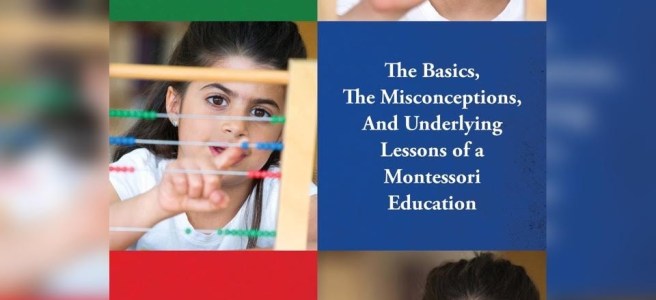
While I never had illusions of creating a best seller, I wanted to write a book that was useful, meaningful, enjoyable, and accessible. I think I accomplished that based on reader reviews and was happy to see that sales have gone over 1250 copies sold. Big thanks for everyone that bought the book and gratitude for all the kind words!

Cosmic Education

Cosmic education can generally be described as the unifying element in the Montessori pedagogy. Simply stated, it avers that all things are interdependent, that humans have a role in the universe, and that each of us have a “cosmic task.” Cosmic education states, grandly, that a human developmental process underlies all growth and, further that education has a role to play in this development. It is the overarching theme of a Montessori classroom, a concept that is unique to the pedagogy, and the thread that holds the fabric of a Montessori experience together. It is a belief that theoretical structures, in all areas of study, should find practical use within our classrooms.
Cosmic education has four main aims. The first is to lead to the development of a whole human being. Academic achievement is not the only goal; rather, the goal is the realization of each child’s natural potential. Learning involves the physical and emotional being, not just the intellect. The second aim is the formation of several types of relationships. These include the relationship between the child and the universe, a sense of marvel and respect for the vast scale of things, and an appreciation of the dignity of all things; the relationship between the child and the processes of life, creating a sense of the process of growth, an understanding of the role of cycles, and the perception of death as a continuation of natural law; and the relationship between the child and humanity, a realization of common needs, a celebration of diversity of culture, and the perception of oneself as a reflection of one’s own culture. The third aim is the realization of responsibility, to all life, to the human species (through family, community, country, and society), and to self, through movement and reflection. Lastly, cosmic education endeavors to create a sense of independent action in the child, teaching him or her to take but give in return, to share willingly and with compassion, and to appreciate conscious and unconscious service.
And how is this implemented? A Montessori education leads children from the whole to the specific, displays the positive aspects of culture and history, employs concrete activities in the curriculum that lead to abstract concepts, uses impressionistic elements and emotions in lessons, and challenges students with ideas, while still providing reflective space towards the process.
Cosmic education, then, is not a singular area of study but rather a connective web that unifies the curriculum, providing both respect and responsibility to the child throughout the school years.

The Three Period Lesson

The term “three-period lesson” can refer to two aspects of Montessori pedagogy. Directly, it refers to the basic structure of a Montessori lesson, with each period corresponding to a section of the presentation. In short, the three periods are often illustrated as follows: “This is…” (first period), “Show me…” (second period), and “What is…?” (third period). A Lower Elementary teacher, for example, in giving a lesson on types of triangles, may present three different wooden triangles: a scalene, an isosceles, and an equilateral triangle. The first period of the lesson would consist of the giving of information and nomenclature. “This is a scalene triangle. All of its sides are of different lengths. This is an isosceles triangle. Two of its sides are the same, and one is different. This is an equilateral triangle; all of its sides are equal.” The second period gives the child a reference point. “Show me the equilateral triangle. Show me the scalene triangle. Show me the triangle with three different sides. Show me the triangle whose name means ‘same sides.’” The third period of the lesson removes that reference. “What is this? Which is this one?”


We can take the concept of the three-period lesson a bit further. We can identify experiences and activities that are giving information as the first period, activities that allow the children to work with the concept as the second period, and the presentation of work as the third period. In traditional classrooms, emphasis is placed on the first and third periods. “Here are the names and dates. In two weeks you will have a test and be asked to give back these names and dates.” Seen in this expanded view, we can see that the vast majority of work in a Montessori classroom is much more meaningful second-period work, such as the activities of children working with the materials, finding similar concepts in the environment, making small booklets, creating timelines, or determining the areas of rugs in the classroom. The child ultimately arrives at “third-period” comprehension, but it is a more profound, internalized understanding.