Toddler and Primary environments serve the first plane of development, the Lower and Upper Elementary classrooms serve the second plane of development, and the Junior Class marks the beginning of adolescence and the third plane of development. The accuracy in this description is apparent if we look at the greater difference between Primary and Lower Elementary students or between Upper Elementary and Junior students. Conversely, the difference between Lower and Upper Elementary classrooms is much smaller.
Further, Montessori described the planes in broader terms. A strong sense of order marks the first plane. We certainly see this reflected in both the children’s activities (sorting, lining up objects, and differentiating items) and the curriculum (sensorial materials and practical life). The second plane is marked as an explosion into the social realm. The methodical 5-year-old morphs into the rambunctious 6-year-old. The Upper and Lower Elementary classrooms meet this need with more group work, more collaboration, and more opportunity for social interaction. The third plane in many ways mirrors the first, as an egocentric phase that is given to tremendous brain growth. Junior students are looking towards adulthood, and their classroom gives them every opportunity to try on new adult roles.
Central to Maria Montessori’s view of an educational system that is child centered and developmental by definition, the planes of development put a structure of common characteristics and tendencies around human growth from birth to 24 years of age. Thus, Montessori observed that children appeared to change into new individuals about every 6 years. She reasoned that if the child developed anew, then it followed that the learning environment and the adults’ approach should also change. She stressed two points. First, if the child reached his or her full potential in the present plane, this created a firm foundation for the successive plane. Second, if the child did NOT realize his or her full development in one plane, he or she would still move into the next plane, but without the requisite academic and social skills. The first plane of development encompasses the years from birth to 6 years of age. Children from 6 to 12 years of age are in the second plane of development. Early adolescence to young adulthood (12 to 18 years old) is identified as the third plane of development. Finally, the 6 years between the ages of 18 and 24 constitute the fourth plane of development. In general terms, Montessori noted that the first and third planes are periods of tremendous transformation and construction, while the second and fourth planes are years of stabilization and strengthening. Each plane is also divided into two subplanes, each of 3 years in length.
Montessori schools are constructed and organized to support the kind of growth and learning that occurs within these developmental planes and subplanes. Toddler and Primary classrooms (first plane) share many like materials, lessons, and emphases, while still being distinct environments. The Elementary classrooms (second plane) represent a large change from the Primary years. While there are also significant differences between the subplanes of Lower and Upper Elementary classrooms, they are fewer and less salient. The Junior Class represents the first 2 years of the third plane of development and is another big jump. Knowing your child’s developmental plane is an important step in understanding his or her needs and setting appropriate expectations.
Category: Uncategorized
The Uninterrupted Work Cycle
In a Montessori classroom, we can broadly categorize the students’ time in two ways. When the entire class is gathered, perhaps for the morning meeting or at the end of the day, the students are “on circle.” This represents a relatively small fraction of their classroom time. The vast majority of a Montessori child’s day is spent in a “work cycle.” The work cycle itself can be divided further into lessons given by teachers and independent work time. Lessons from teachers during the work cycle can be presented on a one-to-one basis, in a small group, or even to the whole class. Independent work time represents the bulk of the work cycle, as students move through the classroom, selecting materials from the shelves and bringing them to a rug, desk, or table. Montessori environments strive to keep this precious time whole and undivided, attempting to keep interruptions to a minimum.
What does the work cycle look and sound like? A stroll around a Montessori school at any time from 8:45 a.m. to 11:30 a.m. or so, and again in the afternoon, reveals the essence of the uninterrupted work cycle. Children are working with friends on floor rugs and at small tables, or at single desks, manipulating learning materials, writing, illustrating maps, having a snack, and so forth. Teachers, who are not big voices and big personalities at the front of the classroom, are notoriously difficult to find, as they present lessons to students with subdued voices. They are also observing, redirecting, and sitting or kneeling at the children’s level. A “Montessori buzz” is heard, that is, the volume is somewhere above library quiet but well below disruptive.
The uninterrupted work cycle is the heart and soul of a Montessori environment. Montessori spoke extensively about the need for children to develop their powers of concentration and focus in order to best internalize and integrate the concepts in which they were engaged. Learning research supports this idea. We learn best when we are focused on the task at hand. Thus, it stands to reason that a school should prioritize the creation of environments most conducive to developing the power of concentration. We cannot bemoan the lack of attention span in our children, blaming our undeniably “plugged-in,” Internet-driven world, if in our schools we are equally at blame, interrupting students every 23 minutes to put away their math books and get out their language worksheets, or values clarification, or nutrition, etc. Instead, a Montessori environment allows children to develop longer periods of attention, and a sense of task completion, by protecting a work cycle measured in hours, not minutes.
From “Follow the Child – The Basics, The Misunderstandings, and Underlying Lessons of a Montessori Education” by Rob Keys
The Prepared Environment
One of the key components of any Montessori classroom is what we refer to as the “prepared environment.” In fact, Montessorians use the terms “classroom” and “prepared environment” interchangeably. At first glance, we might dismiss the term as being too obvious. Isn’t every classroom a prepared environment in some sense? But as we discover more about the inner workings of the Montessori pedagogy, we find that the term is a rich and many-layered description. We can think of it as having three main components: the classroom materials, the adults (or “directresses” and “directors”), and the other children in the space. Physically, the classroom is arranged to be conducive to the children’s independent, self-directed work. We notice low shelves, inviting materials, and work spaces both on the floor with work mats and at tables for both group and individual use. The hands-on materials are designed to meet the learning needs of the children in the relevant age group and are presented in lessons and then placed in the environment in a logical and sequenced manner. The adults in the classroom are well educated in the didactic use of the materials as well as in child development, and they actively support a classroom culture of challenging work, movement, and independent work. Lessons in responsibility, in grace and courtesy, and in sharing become part of the fabric of this environment, prepared to best suit a child’s learning.
The prepared environment describes a classroom that has been laid out carefully and methodically to maximize the independent and spontaneous work of the child. The pedagogy is based on the foundation that children move through the different stages of development as part of their natural growth. They will independently acquire what they need if they are presented with the appropriate concepts, at an optimum age, with manipulative materials. Any effective environment for children needs to be set up in such a way that the children can access the materials, which are laid out in a logical manner, with a maximum amount of independence and a minimum amount of adult direction. Further, the classroom must be beautiful and peaceful in order to better allow each child’s energies to flow without obstacles or distraction.
The Montessori materials themselves, as part of the prepared environment, also have a strong role to play. Besides their pedagogical function (hands-on, self-correcting, isolation of concept and difficulty), they too are objects of beauty. Montessori believed that working with quality materials, such as tongue-and-groove boxes, wood and glass pieces, and beads, is a crucial element to a child’s learning that would be diminished if the materials were rendered in cheaper plastic, shabbily made, or easily broken.
Of course, we can also see that the term “prepared environment” must refer to more than the tables, the desks, the rugs, and the Montessori materials, to include the rest of the children in the classroom, the teachers, the daily schedule, etc. Thus, the role of the “teacher,” which is better translated from Montessori’s Italian as the “guide, directress, or facilitator,” is less to talk at children than to prepare a classroom environment that will best facilitate a natural process already present in each child.
Darchei Noam
I know I’ve spoken of the array of Montessori experiences in a variety of settings before. If my time in Montessori these 30+ years is anything, it has been revelatory in the knowledge that this pedagogy thrives in such a wide spectrum of environments. A hardy plant that grows where planted indeed. Rural, urban, affluent, struggling, religiously-based, humanistic-themed. That I have been afforded opportunities to teach in an airport hangar classroom in Haiti, a public school program in Seoul, a Christian-themed school in Indonesia, with a Muslim-owned Montessori materials company in the States, a village-school in Ghana, etc…. is such a gift. And this Fall, a conservative Judaic-based school in Maryland.
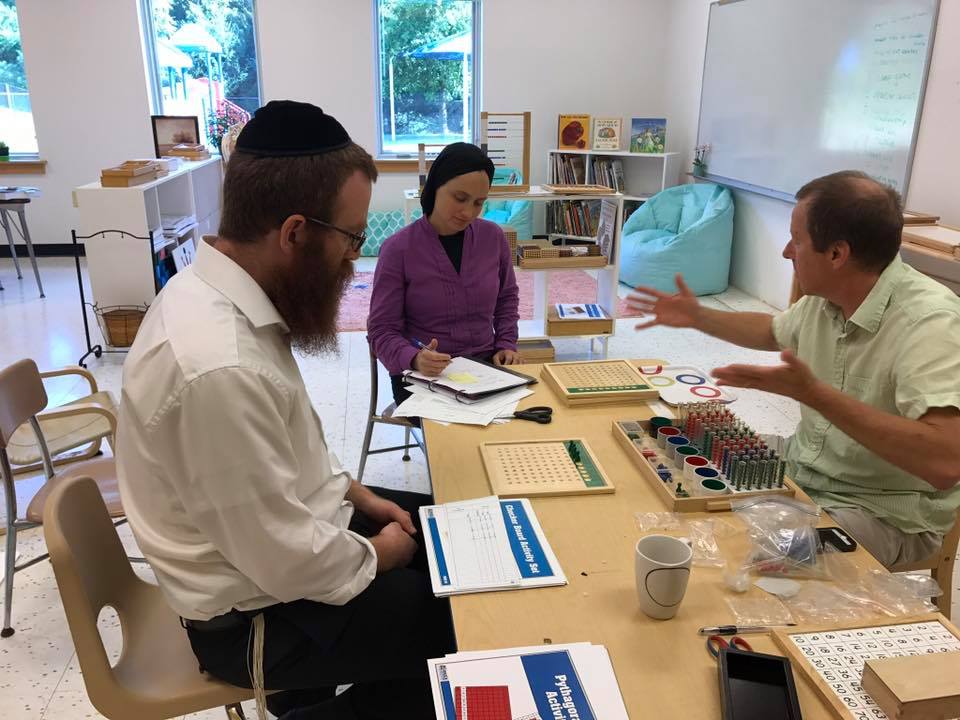
In a small town just west of Baltimore is a small but growing Montessori school named Darchei Noam, which translates literally as “pathways of pleasantness”. This academic year, two new elementary classrooms have been launched by Head of School, Brocha Baum. To say Brocha is a dynamo, a mere creator of energy, is to undersell the term. She creates, harnesses, takes on too much, and gets it done anyway. Have you encountered these people before in your lives? Cindy Swenson with Project Okurase, Ladene Conroy in Charleston come to mind. Montessorians that are tireless in their efforts towards a constantly evolving and expanding goal. Anyway, after a summer session of teacher-training, we’re a few webinars into the school year, and it feels like I’m reading, for me, a new chapter in Montessori. The differences are not small. The classrooms are gender segregated, a boys class of 18 and a girls class of 14. Judaic studies is an additional component of the curriculum. In February,
I’ll be able to observe the classrooms in action, and I’m really looking forward to the experience. But the discussions with the teachers echo a hundred conversations I’ve had with new teachers over the years. “How do I engage the children in new work?” “What do I do with a child that won’t settle during the work period?” “How many presentations should I be giving a day?”
I’m confident this program will succeed. The teachers are “on board” with the pedagogy and with the mission of the school. And besides, Brocha will not allow anything less!
Montessori in Ghana
One of the experiences I’ll look back upon in my dotage, which some days feels like it’s speeding towards me like an oncoming truck, is being able to see Montessori changing lives in a wide variety of settings. It’s been such a honor to work with teachers from a makeshift classroom in a factory in Port-au-Prince, Haiti to a private school in New Hampshire. From a public school in Savannah, Georgia to a public program in Seoul, South Korea. A conservative Jewish school in Baltimore with Hebrew sandpaper letters. A Christian elementary school outside of Jakarta, Indonesia. This past summer, I spent two weeks working with five teachers, soon to open the first “real” (not just in name only) Montessori school in the country. Many thanks to Project Okurase, a non-profit organization doing so much good in Ghana, West Africa for the invitation. Among its many efforts, such as an annual health outreach, adult vocational program, and a sustainable farm, they are starting a Montessori school in the village of Okurase, about an hour and a half northwest of the capitol city of Accra. Two lead teachers and five assistant teachers were hired in June, but the two leads never showed up! It became clear as I worked with the remaining five, that they were bonded, dedicated, and highly competent teachers. By the time we had completed our weeks of teacher education, they were truly the lead teachers, committed to their craft, to the school, and to the community. The school is named, “Nkabom Montessori School”, which means “unity”. A better name you’ll seldom find.
AMS Conference
Very nice to have been in San Diego for the weekend. Aside from the fact that it wasn’t 8 degrees it’s always gratifying to be in the company of so many colleagues. The variety of experience within the scope of “Montessori” is staggering. It crosses geography, culture, and language. Public and private, charter and magnet. Differences emerge but they pale in comparison to the commonality of pedagogy and purpose.
Montessori in the Low Country

Last week, while my home was being buried in 3 1/2 feet of snow, I escaped to Savannah for some more teacher training at Charles Ellis Academy, and observations at schools throughout Low Country. It was with great anticipation that I observed in some schools that I had heard about but had yet been able to visit. James Simons and Murray-LeSaine are both in Charleston, SC. Low Country Montessori, Beaufort Elementary, and River Ridge Academy, between Savannah and Charleston, were all new to me. It’s with special interest that I observe Montessori being employed in a variety of locations and environments, with a diversity of students, but with a common thread of pedagogy. The rise of Montessori in the public sector is simply stunning. In 2002, there were barely 200 such schools, by 2015 there were nearly 600! If what I observed is any indication of the quality of Montessori education, then certainly the kids are all right.
Thank you, Ridgewood Montessori!
Many thanks to Helen Ross and the faculty of Ridgewood Montessori School in Paramus, New Jersey for hosting me on Monday, January 16th. Dr. Montessori’s Five Great Lessons was our topic and the discussion could not have been richer and more informative. I was so impressed by the interest and energy of this wonderful group of colleagues.
Follow the Child Review
“Follow the Child” was just reviewed in the latest issue of Montessori Life (Fall 2016). Click the link icon below to check it out!

Lecture in Savannah

Wonderful to have the opportunity to speak to parents at the Charles Ellis Montessori Academy, the largest provider of Montessori education in Savannah, a public K-8 magnet school serving 560 students. Looking forward to continuing teacher education with these dedicated teachers this summer!