
the constructor

Dr. Montessori often used the word, “costruire”, the translation from the Italian being “to build, create, to construct”. Before children can become Greeks (working abstractly), they must first be Egyptians (use their hands). One could write a treatise (or two!) on the myriad of ways a Montessori prepared environment provides opportunities for a child to construct, both physically, cognitively, and even as a metaphor for emotional and social growth. Specific to a manipulative material, the Geometric Cabinet can serve as an excellent model for the concept of construction.

The Geometric Cabinet is one of the more important and versatile geometry materials we have in our Montessori classroom. It is, or should be, present in every Early Childhood and Lower Elementary classroom, but it is also used (more likely borrowed) in many Upper Elementary environments as well. It is a beautiful material to display. The large wooden cabinet with six drawers brings attention to itself and adds to the impressive array of our Montessori environments.
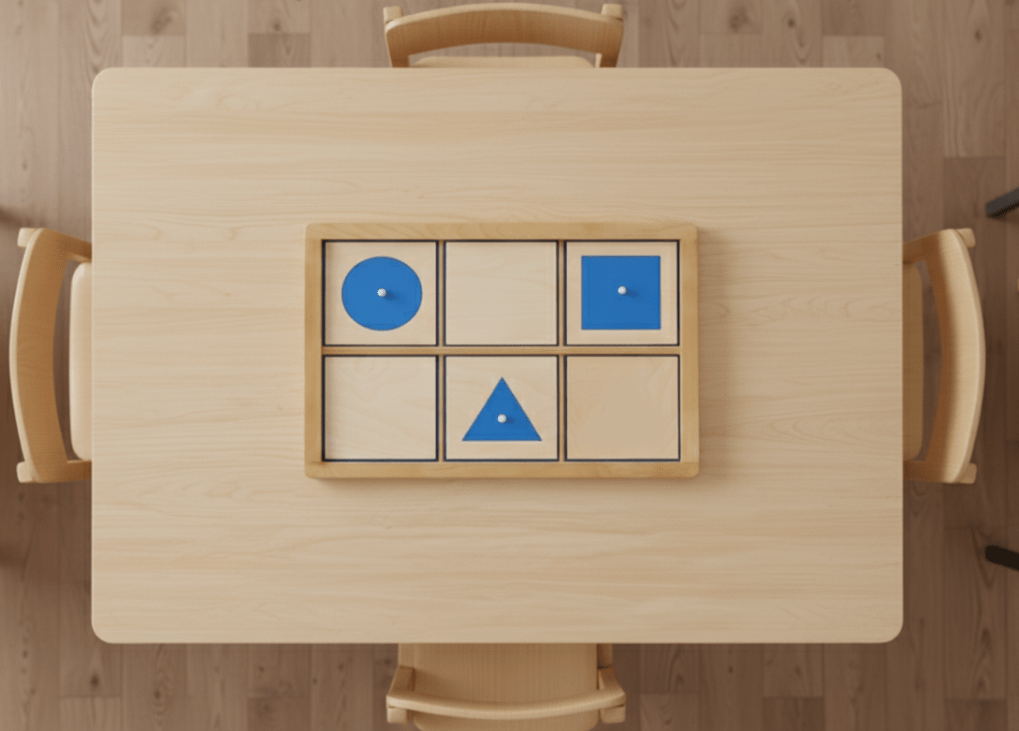
Demonstration Tray

Traditionally, a “Demonstration Frame”, that sits on top of the cabinet, holds the Circle, Square, and an Equilateral Triangle. In some schools the order of the drawers differs from Early Childhood to Elementary environments. It is also important to note that there is no set of specific figures present in the cabinet. Certainly, there is always a Triangle Drawer, a Polygons drawer, a Rectangle drawer, and a Circle drawer. There is almost always a Quadrilateral drawer, but the sixth drawer can sometimes be Curved Figures, but a Miscellaneous Figures drawer is not uncommon!.

The first drawer displays triangles; acute-scalene, right scalene, obtuse-scalene, acute isosceles, right isosceles, and obtuse isosceles. The drawers present these shapes in two rows of three. How to order them? One suggestion would be the scalene, isosceles, and equilatreal across the top row to classify by sides  the bottom row to show examples by angle. Right-angled in the first column, obtuse-angled in the middle column, acute-angled in the right. We put those after the right as they are both determined by their relationship to a 90 degree angle.
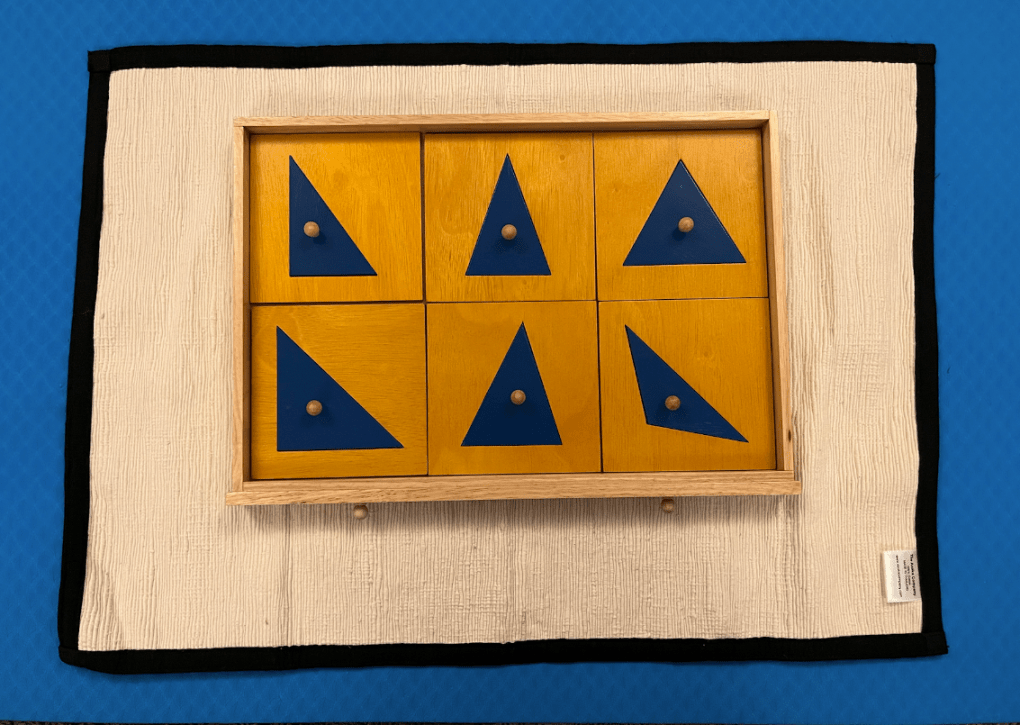
The Geometric Cabinet

The second drawer displays quadrilaterals; trapezium (sometimes referred to as a common quadrilateral), parallelogram, trapezoid, and rhombus, The third drawer displays rectangles. There are six shapes total, five rectangles with gradually lengthening bases, and one square in the bottom right corner. The fourth drawer is a set of six regular polygons, and they are arranged by number of sides. The pentagon, hexagon, septagon make up the first row. Octagon, nonagon, and decagon round out the second row. The fifth drawer contains the circles. Again there are six, of different diameters starting in the top left (5cm) and ending in the bottom right (10cm). The 10cm circle matches the demonstration tray circle mentioned above. These drawers, with these figures, are common to every Geometric Cabinet.
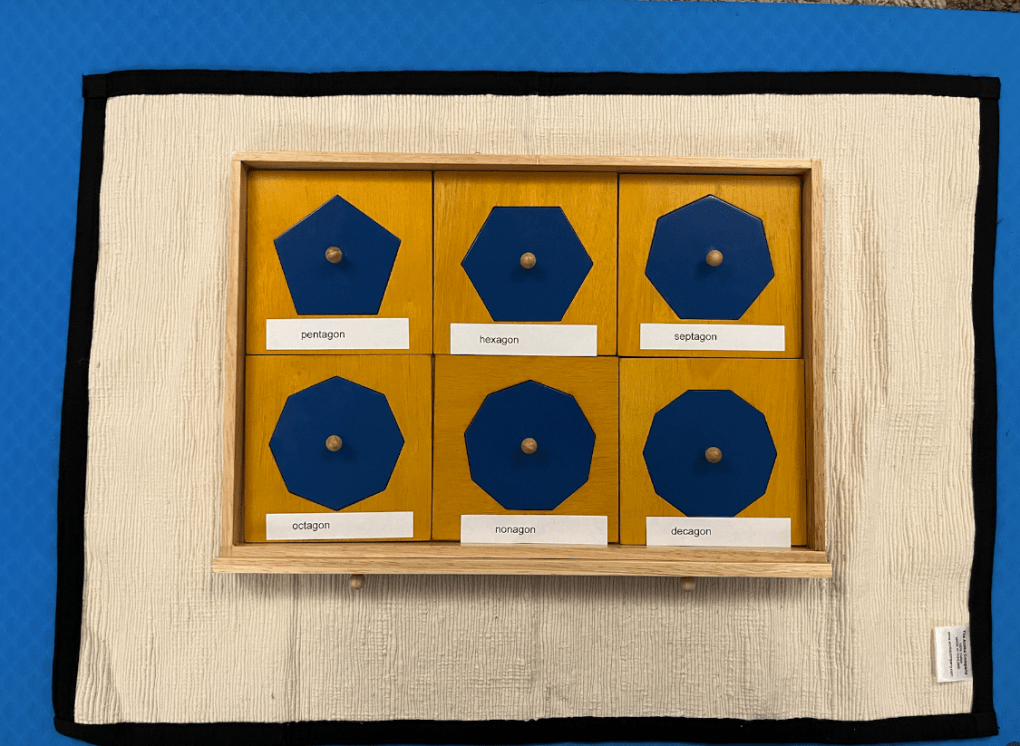
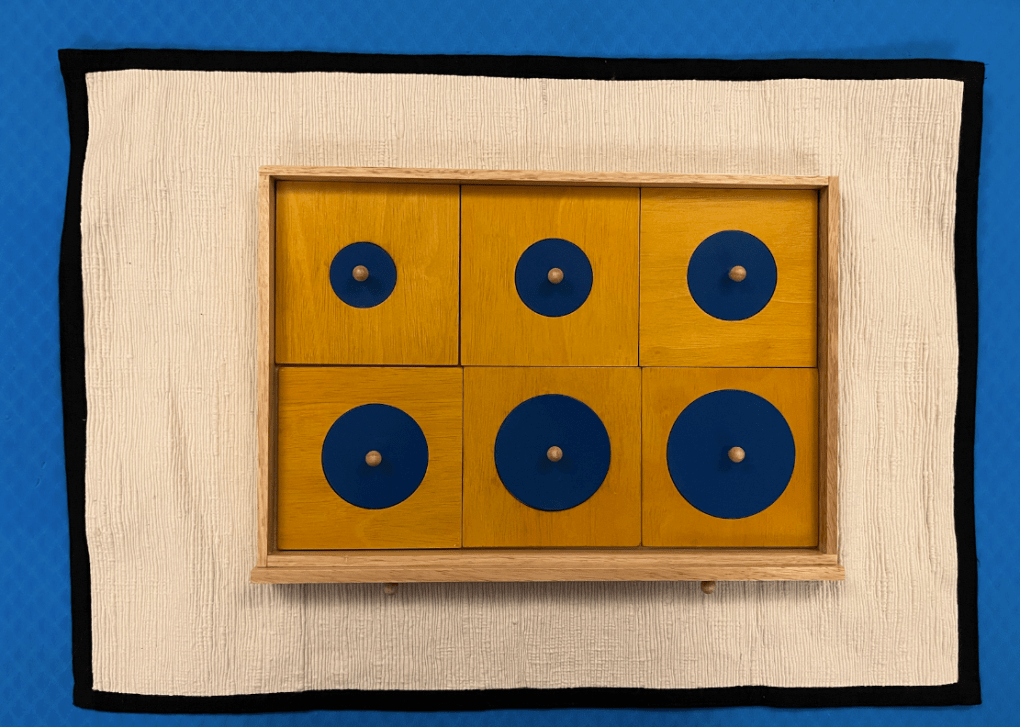
The Geometric Cabinet

The Geometric Cabinet

A common, and desired sixth drawer contains curved figures. The oval and ellipse certainly, quatrefoils and a curviliinear triangle maybe. The curvilinear triangle can also be called a Rouleaux Triangle, named after Franz Reuleaux,a 19th-century German engineer who pioneered the study of machines for translating one type of motion into another, and who used Reuleaux triangles in his designs. As one could probably guess, the design itself predates him by centuries. Perhaps he had a better PR firm? The contents of some sixth drawers, as mentioned earlier, will use the drawer for miscellaneous figures, like the delta (kite) or a convex quadrilateral (boomerang).

The Cabinet is supported in both Early Childhood and Elementary classrooms with cards that match each figure. Typically the child starts with cards that are solid figures, then those with thick outlines, and finally a thin line outline. Labels for each figure can also be purchased or teacher-written. A companion material would ceratinly be the Constructive Triangles. It even has construct in its name, after all. It also represents a material that is presented not just in early childhood and lower elementary classrooms, but upper elementary as well.

still learning after all these years

Way back in the day of my Montessori career, like early morning, I gave my first talk at an AMS National Conference. So long ago that it wasn’t yet called the Montessori Event!. I’ve added an exclamation, but perhaps that’s how it’s supposed to be spelled and pronounced now? In any Event (see what I did there?), that year it was in Chicago and my rather ambitious topic was “Zen and the Art of Montessori Teaching”. Leading up to the presentation I had nightmares, envisioning a group of saffron-robed Buddhists shouting me down as “not knowing what I was talking about”.  As I was barely thirty-years old at the time, those dream monks may have had a valid point. The main thrust of the talk was how difficult it was to stay present as a classroom teacher, to stay in the moment, to stay in the “now”. How difficult it was to maintain a “beginner’s mind”, a concept explained beautifully in Shunryu Suzuki’s seminal book, “Zen Mind, Beginner’s Mind”. The idea being that often it is our younger and less experienced teachers that bring a more valid view to a classroom, a child, a material. They are unburdened and unshackled from preconceived notions of an area of the environment, or the behavior of a child.  “We can’t put the group circle there, because I’ve tried that before and it didn’t work”. “That intervention won’t work for them, because I had a student just like that before and it didn’t work”. It could well come to pass that a new teacher tries something and observes the result to be disastrous, but at least it fails on its own merits. There’s honesty there. My presentation concluded along the lines of keeping yourself open to new visions, strategies, concepts, children, because truly we never experience the exact same classroom twice, even moment to moment. In more modern, more trendy language, it would probably translate to “keep and cultivate a growth mindset”, but I like “beginner’s mind” better.

This past week, I gave a series of webinars online, at the request of Alison’s Montessori; the subject being Geometry at the Elementary Level. Included in the many materials I presented, was the Triangle Drawer of the Geometric Cabinet, specifically, The Sum of the Interior Angles of a Triangle. It’s one of my favorites. Tracing the Seven Possible Triangles in the Universe, children color the angles in red, cut them out, and lay them angle to angle to angle, showing they form a straight line, a straight angle, 180 degrees. It  illustrates quite elegantly the difference between a traditional school experience, starting with the answer and those dry “If…. When” statements from 9th grade Geometry textbooks, and a more constructivist model in a Montessori classroom, done when the student is ten years younger and ten years more interested in Geometry. Not wanting to reveal in great detail just how old I am, I have probably given that presentation a few hundred times to both children and adult learners. It’s hard to hold on to that beginner’s mind when your mind could probably do that lesson and check email at the same time (Important Note: I didn’t do that). “Are there any questions?”, one politely asks the group at the end of any lesson. I was only mildly flummoxed when a teacher asked, “Why?”.  “Why do we show this lesson?”, I replied.  “No, why do the interior angles add up to 180 degrees?”  My brain rolodex started to spin… surely I knew the answer to this question… had no one ever asked me such an eloquently simple thing? Much like the Grinch when he attempts to assuage Cindy Loo Who (who was no more than two), I fumbled a bit, drawing circles around each angle… in the end admitting that I was botching the whole thing quite royally. Sigh. The next day, it was off to the Internet to find the answer.  My son, Elijah, famously (at least in our family) stated that “if you have a question, someone else had the same question”. Sure enough, there were a great many sophisticated geometry websites that gave various ways to prove the theorem, but I was looking specifically for one that could be adapted to a Montessori material. I was very satisfied to find one, using the congruency of alternate interior angles, which is a separate Montessori presentation, in the proof. Rapture! I eagerly awaited the next evening’s webinar to show the group (see photo below). It’s debatable who was the most excited, me or the webinar participants!

Dismay at not knowing the answer to the initial question quickly evaporated, to be replaced by a much more comforting thought that there are still things to be learned, still lessons to be revealed, even within experiences we’ve lived over and over.