the constructor

Dr. Montessori often used the word, “costruire”, the translation from the Italian being “to build, create, to construct”. Before children can become Greeks (working abstractly), they must first be Egyptians (use their hands). One could write a treatise (or two!) on the myriad of ways a Montessori prepared environment provides opportunities for a child to construct, both physically, cognitively, and even as a metaphor for emotional and social growth. Specific to a manipulative material, the Geometric Cabinet can serve as an excellent model for the concept of construction.

The Geometric Cabinet is one of the more important and versatile geometry materials we have in our Montessori classroom. It is, or should be, present in every Early Childhood and Lower Elementary classroom, but it is also used (more likely borrowed) in many Upper Elementary environments as well. It is a beautiful material to display. The large wooden cabinet with six drawers brings attention to itself and adds to the impressive array of our Montessori environments.

Demonstration Tray

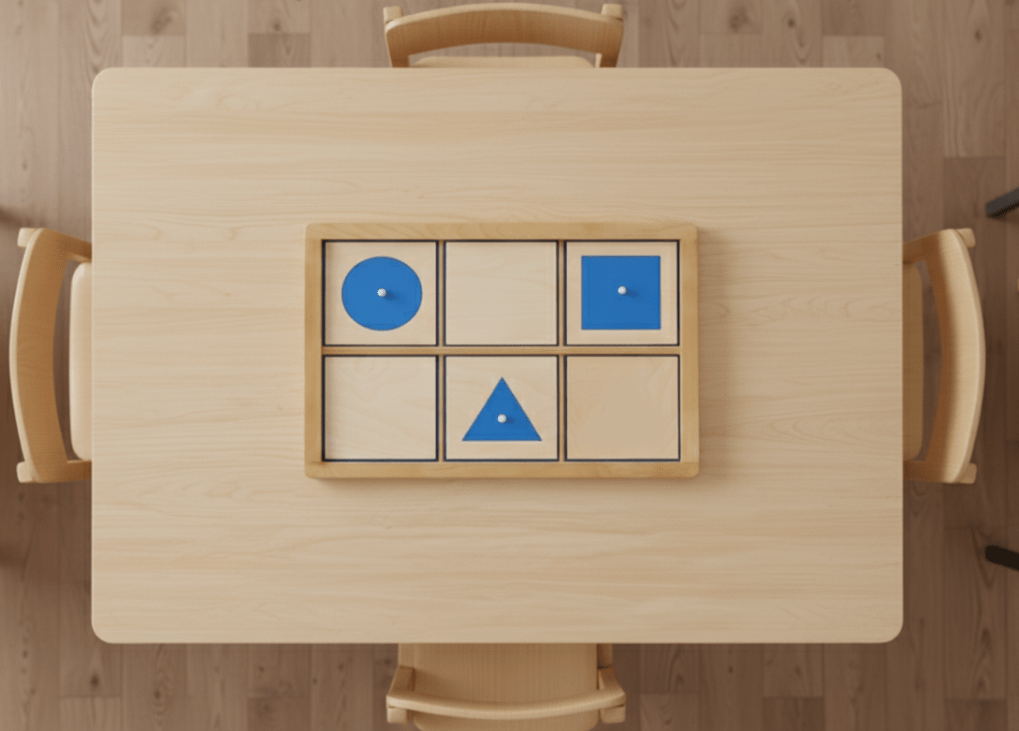
Traditionally, a “Demonstration Frame”, that sits on top of the cabinet, holds the Circle, Square, and an Equilateral Triangle. In some schools the order of the drawers differs from Early Childhood to Elementary environments. It is also important to note that there is no set of specific figures present in the cabinet. Certainly, there is always a Triangle Drawer, a Polygons drawer, a Rectangle drawer, and a Circle drawer. There is almost always a Quadrilateral drawer, but the sixth drawer can sometimes be Curved Figures, but a Miscellaneous Figures drawer is not uncommon!.

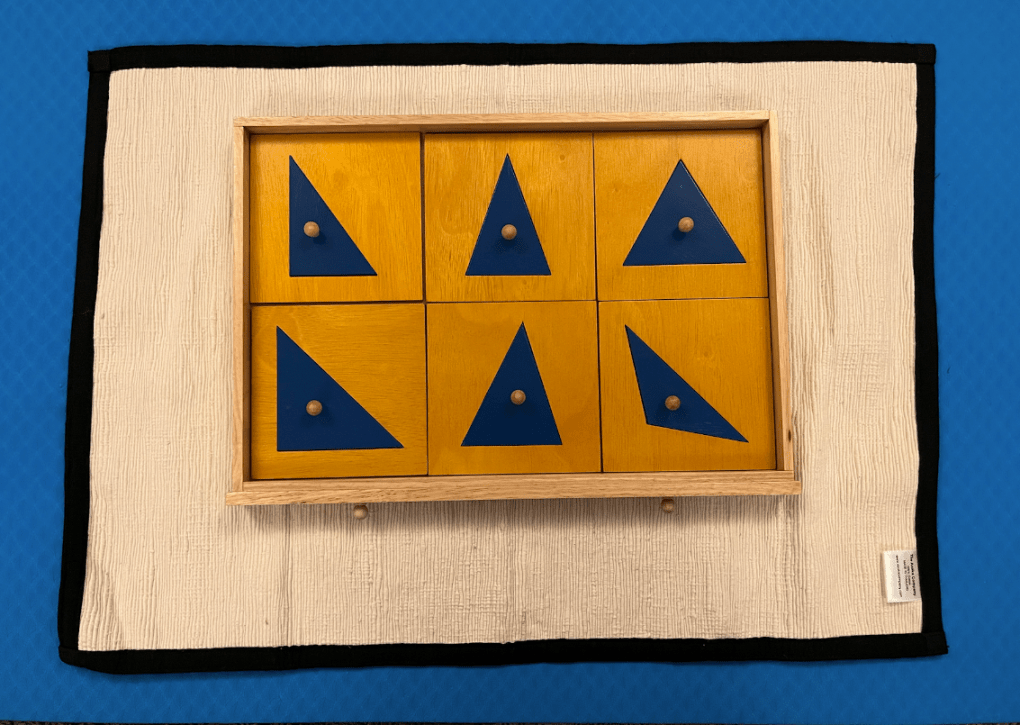
The first drawer displays triangles; acute-scalene, right scalene, obtuse-scalene, acute isosceles, right isosceles, and obtuse isosceles. The drawers present these shapes in two rows of three. How to order them? One suggestion would be the scalene, isosceles, and equilatreal across the top row to classify by sides  the bottom row to show examples by angle. Right-angled in the first column, obtuse-angled in the middle column, acute-angled in the right. We put those after the right as they are both determined by their relationship to a 90 degree angle.

The Geometric Cabinet

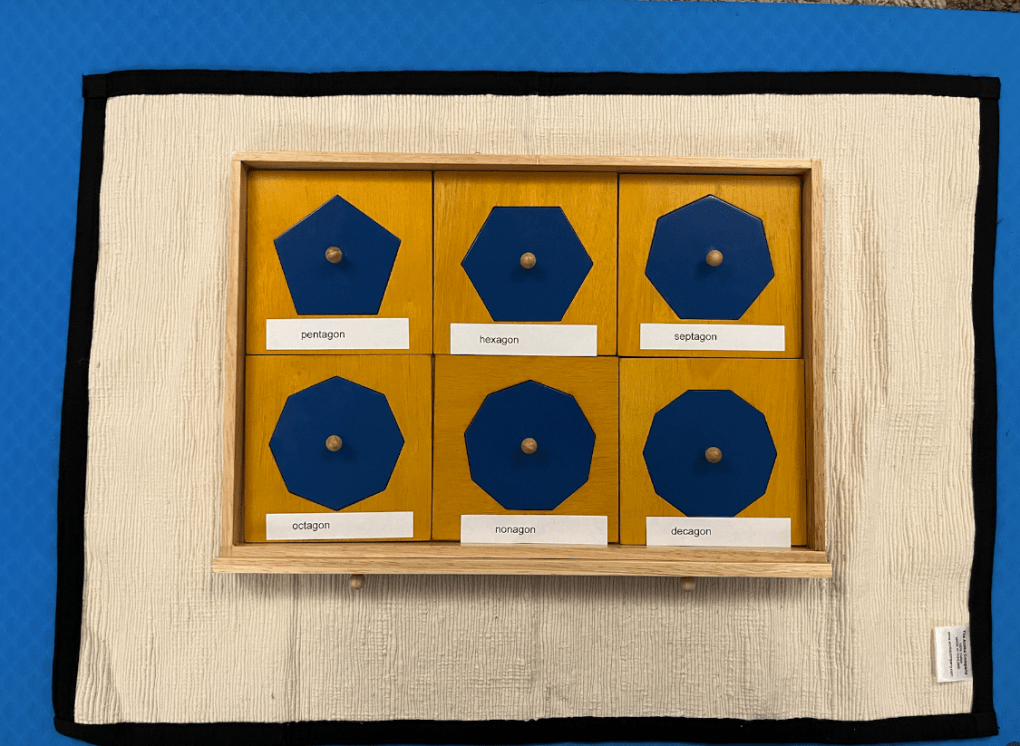
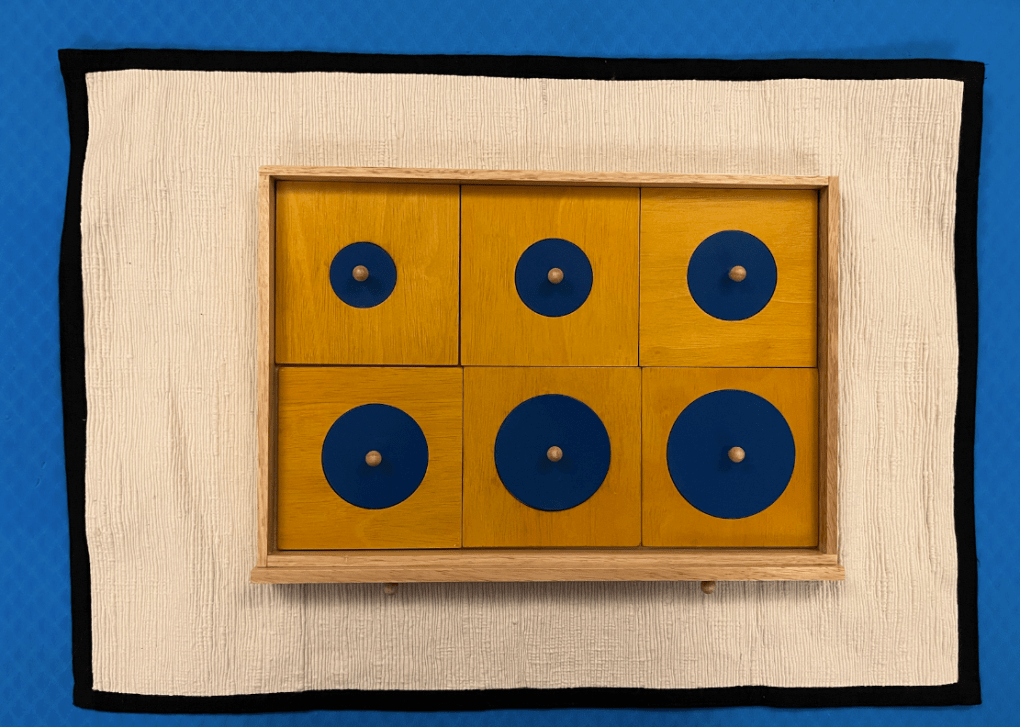
The second drawer displays quadrilaterals; trapezium (sometimes referred to as a common quadrilateral), parallelogram, trapezoid, and rhombus, The third drawer displays rectangles. There are six shapes total, five rectangles with gradually lengthening bases, and one square in the bottom right corner. The fourth drawer is a set of six regular polygons, and they are arranged by number of sides. The pentagon, hexagon, septagon make up the first row. Octagon, nonagon, and decagon round out the second row. The fifth drawer contains the circles. Again there are six, of different diameters starting in the top left (5cm) and ending in the bottom right (10cm). The 10cm circle matches the demonstration tray circle mentioned above. These drawers, with these figures, are common to every Geometric Cabinet.

The Geometric Cabinet

The Geometric Cabinet

A common, and desired sixth drawer contains curved figures. The oval and ellipse certainly, quatrefoils and a curviliinear triangle maybe. The curvilinear triangle can also be called a Rouleaux Triangle, named after Franz Reuleaux,a 19th-century German engineer who pioneered the study of machines for translating one type of motion into another, and who used Reuleaux triangles in his designs. As one could probably guess, the design itself predates him by centuries. Perhaps he had a better PR firm? The contents of some sixth drawers, as mentioned earlier, will use the drawer for miscellaneous figures, like the delta (kite) or a convex quadrilateral (boomerang).

The Cabinet is supported in both Early Childhood and Elementary classrooms with cards that match each figure. Typically the child starts with cards that are solid figures, then those with thick outlines, and finally a thin line outline. Labels for each figure can also be purchased or teacher-written. A companion material would ceratinly be the Constructive Triangles. It even has construct in its name, after all. It also represents a material that is presented not just in early childhood and lower elementary classrooms, but upper elementary as well.

fingers pointing at the moon

Masha spent the first few weeks in Tel Aviv in a bomb shelter. In an incredible act of bad timing, her long-awaited move to Israel coincided with the missile exchanges of mid-June. I had landed in Jakarta shortly after and we started an exchange of long emails that tended to run to the more thoughtful and philosophical. I met Masha in Chicago in the summer of 2023 when she was enrolled in a teacher-education program run by the Center for Jewish Montessori Teacher Education, a course I co-directed.. Two summers later and both of us were a long way from home. She wrote that she was curious as to how the Montessori schools in Southeast Asia were the same, how they differed. The question got me thinking in a broader sense, about how the spectrum of Montessori is interpreted across cultures.

I’ve written before regarding my experience of teaching adult learners in disparate parts of the Montessori world; Seoul, Savannah, Ghana, Charleston, Haiti, Baltimore, Shanghai, Buffalo, Florida, Chicago, Portsmouth, and Indonesia both decades ago and more recently last month, in Jakarta. The lens I would use was grounded in geography and setting and even school budgets; a Montessori classroom in an airplane hangar in Carrefour, Haiti, a $100,000 worth of materials with which to present in Shanghai. Another lens is theological. While most all of my work has been in secular programs, I’ve also been fortunate to teach against the backdrop of the world’s most populous religious traditions.

There’s a universal experience that I’ve felt with Montessori, especially now having been associated with Christian, Jewish, and Muslim communities of adult learners. A commonality among religions and the non-religious as to what inspires parents for their children, and what they hope a school environment will provide and nurture. Raising independent creative thinkers in nurturing classrooms that provide for the emotional and social development, not just academic achievement seems to be something that doesn’t care who you pray to. So things like parsha and davening, the Koran, the Torah, catechism, parables, learning Hebrew or using an Arabic moveable alphabet, those get woven into a tapestry of Montessori, quite easily. Like any course, there’s a difference in orthodoxy that’s reflected in the training, but there’s a baseline respect that you expect adult learners to share with the cohort, and that’s always been the case with my groups over the years. I don’t know as much about the scope of schools where these teachers will be guiding children. It’s clear that there’s a diversity in socio-economics, as there is everywhere, including the U.S., but in developing countries those lines are more jagged. I saw bead frames made of plywood and string instead of maple and gauge wire, but it’s a bead frame. Adds the same way. There’s a Buddhist concept that metaphors different religions as fingers pointing to the moon.  Some people, even and in some cases especially the learned and “holy”, get caught up in whose finger is more devout, which finger is more accurately pointing to the transcendent and resplendent. Forgetting the moon entirely.

During a speech at the Montessori Teaching College in London, Mahatma Gandhi, referencing a speech by Dr. Montessori, famously said, “If there is to be peace in the world, it will begin with children.” Children tend to see the moon, so perhaps the universal appeal of Montessori to parents can play some role in resolving conflict. The subjunctive use of the word “if” has always interested me. Gandhi was hopeful, but from experience a realist as well. Masha writes that the ceasefire has allowed her more time up and out instead of down and in. She’s looking for work, planning on contacting Montessori schools, applying for a position. Masha is both kind-hearted and open-minded, curious, and growth-centered. She’ll be fine, great in fact. I hope she keeps writing.