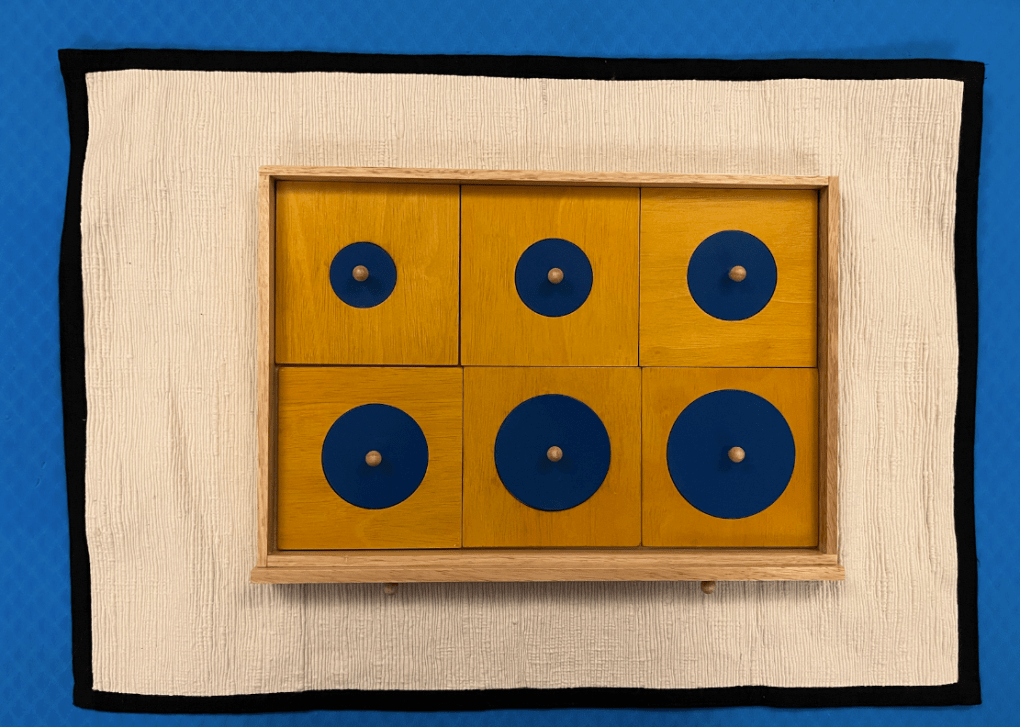
Most adults observing a Cornerstone classroom are quick to notice its strengths. The use of manipulative materials, the small group lessons, the beauty of the prepared environment, the freedom of movement, all form an impressive tableau. A more in-depth observation would also clearly reveal the integration of subject areas, the social interaction, and the element of choice. Within that structure, students move with purpose (most of the time) and ease, seemingly without adult compulsion. Children voluntarily seek out activity, come to lessons willingly and happily, work with peers of their own accord, and, with guidance, take responsibility for their education. The structure for this drive does not come from a draconian adult or some other extrinsic force. Instead, the children appear to have an intrinsic urgency to act upon the environment. Why?
A crucial aspect of any Montessori classroom is perhaps less discernible due to its conspicuousness. The driving force in the child’s interaction and progression through the curriculum is deep interest. It is the tree that can’t be seen for the Montessori forest. This passion is created through creative and impressionistic lessons, the presentation of grand concepts, the use of large numbers, the emphasis on the power of imagination, and the liberty to choose a compelling activity for one’s self. More than a natural incentive, interest further serves as a powerful tool for learning. Studies clearly show that we are much more likely to assimilate information if it holds strong interest. One such study had participants list a series articles in terms of their interest. Not surprisingly, comprehension scores on these readings mirrored the ranking given. Areas of higher interest naturally hold our attention, heighten our focus, and compel us to iteration and practice. Consequently, the learning that takes place is more meaningful, more profoundly held, more deeply understood, more logically connected and synthesized.
And need we mention joy? So, at the end of the day (the metaphorical day, not 3 o’clock dismissal), it is the child’s likely response that speaks volumes in its simplicity. “Why do you like going to school?” “It’s fun.”
A Montessori education provides a rich and integrated curriculum that stresses learning in context. The study of geometry includes a study of its Latin roots, a study of unlike denominators in arithmetic includes the writing of the rule, a study of an ancient civilization coincides with a study of rivers, ph studies evolves into soil testing. Specific Montessori materials can also reflect this sense of context. For example, the Detective Triangle Game, located on the language shelf, consists of a box of triangles of different types (scalene, isosceles, etc…) in different colors and of different size. Labels accompany the work: “Find the large, red, equilateral triangle.”…etc; geometry as a grammar work. Speaking more broadly, the concept of Cosmic Education, unique to this pedagogy, is the overarching theme of a Montessori classroom. It holds the fabric of a Montessori experience together and places everything the child learns in context. Cosmic education states, grandly, that a human developmental process underlies all growth, and further, that education has a role to play in this development. It is a belief that theoretical structures, in all areas of study, should find practical use within our classrooms. Simply put, Cosmic Education presents three concepts; that all things are interdependent; that humans have a role in the universe; and that each of us has a cosmic task.
One aim of Cosmic Education is the development of the whole human being. It would follow then that academic achievement is not the only goal of a Montessori classroom. The child will realize their full natural potential, learning that involves the physical and emotional being, not only the intellect. A second aim is the formation of relationships. By building a sense of marvel and respect for the vast scale of things and appreciating the dignity of all things, we show a relationship between the child and the universe. A third aim is the realization of responsibility, to all life, to the human species, and to the child themselves. And a last aim is one of independent action. In broad terms to take, but to give in return, to share willingly and with compassion, and to appreciate both the conscious and unconscious service of those plants, animals and humans that have come before us. Cosmic Education then, is not a singular area of study, but rather a connective web that unifies the curriculum, providing both respect and responsibility to the child throughout their school years.
With the bead frames and checkerboard, the children were not able to carry out division. The concept of division was given with the decimal system material (golden beads), where they saw the beads distributed into equal parts. Then they saw it with the stamp game as both distributive and group division. The memorization materials worked parallel to these earlier lessons and were an important preparation for this later stage of work. Learning those combinations, as well as their multiplication facts will enable the child to carry out the division quickly.
The Stamp Game, Bead Frame, and Checkerboard, lead the child to abstraction in addition, subtraction, and multiplication, quite elegantly in fact. Division is different. The lessons presented with the decimal system (golden bead) and again with the stamp game used distributive division to find the answer, the quotient in a division problem. To divide abstractly, the child must learn group division. “You get one, you get one, you get one, you get another, you get another you get another…” results in the correct answer, but is a different skill from “How many of these are contained, go into, this?” To lead the child towards this abstraction, we will put special emphasis on the recording of our work.
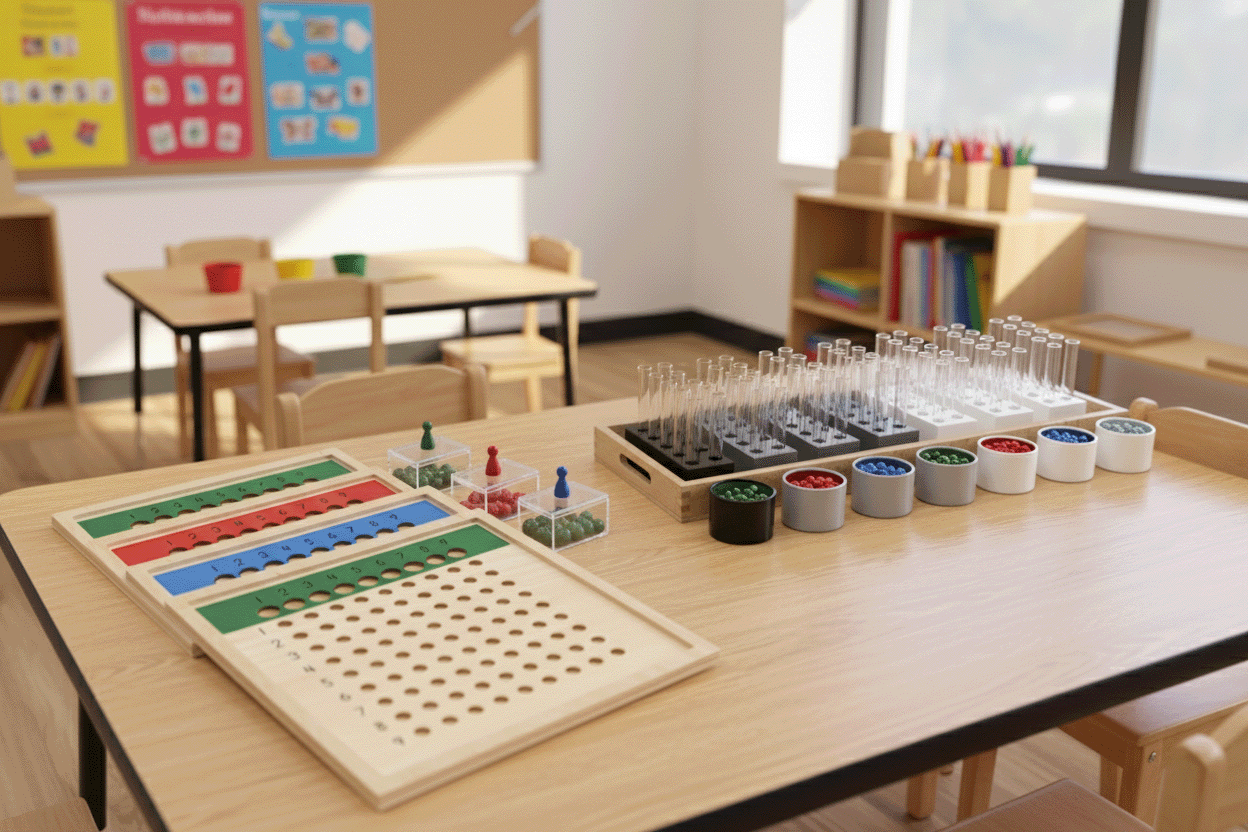
The Hierarchical Material which consists of seven test tube racks: 3 white (containing green, red, blue beads), 3 gray (with green, red, blue beads), and one black (with green beads). Matching these are seven bowls with matching external colors: 3 white, 3 gray, one black, and internal colors: that are hierarchical, meaning the unit bowls are green, tens are blue, and hundreds are red. In each rack there are ten test tubes 10 beads in each tube, so lots and lots of beads! To perform the distribution, there are four boardsm each with 81 holes/ two green (units and units of thousand), one blue, one red. Finally, there is a box containing many green, and red skittles to represent our divisors
The first division done with the child may be relatively simple, although the material allows children to work with dividends in the millions. Some children will enjoy the challenge of starting with a seven digit dividend while others will find it overwhelming. Our first example is based on a dividend formed of at least two or three digits. The divisor is one digit. There should be no remainder in the initial presentations.
Start with the problem such as: 4)9764
The first time we will only write the quotient. In order to reduce confusion, we will remove from the tray only the necessary holders and bowls.
Form the number by putting the correct hierarchical beads into the bowls to form the dividend and place them closer to the child and to their right. Then put out 4 green skittles on the green board.
Bring the 1000’s bowl up to the bottom of the board and distribute them to the four skittles. We see we can give two to each. But we have one we are unable to distribute. Place it in the 100’s bowl. Write 2 (what each skittle received) above the 9 in the dividend. Pick up the green beads on the board and put them back in their test tubes, referred to as “clearing the board”. Turn the now empty thousands bowl over and slide off to the left of the child.
Look in the 100’s dish. There are 7 reds and 1 green. The green can’t stay so change it for 10 reds (a full tube). Then distribute the reds (100’s). We can give 4 to each skittle. Record a 4 in the hundreds place. We have one red we can’t distribute. Place it in the 10’s bowl. Then pick up and put away all the hundreds beads, turn the bowl over and slide off to the left.
Move the tens bowl up to the board. Look in the bowl; there are 6 blues and 1 red. Change the red for 10 blues. Distribute the tens. This time there are none remaining. Record a 4 in the tens place, pick up the beads and put away the tens bowl.
Move the units bowl up. There are 4 green unit beads to be distributed, and each skittle receives one. Record this final number in the quotient. A good note to keep as a reminder for this presentation is, “beads first, record quotient only”.
Children benefit from lots and lots of repetition at one level of complexity before moving on to the next. I would use the word “facility” meaning there is an ease and confidence in their working through the problem. Perhaps that’s difficult to define quantifiably, but as a parent/teacher, you’ll recognize it when you see it. When it does come time to move ahead, when the child is ready to move from this concrete experience to the next level, we’ll take a small step by simply recording our work, resulting in a problem on paper that will follow the same algorithm we all learned in our childhood classrooms. Here the reminder will be, “beads first, record all work”. To isolate the difficulty, which is a component of Montessori lessons, use the same problem a child has already completed. In repeating the problem above, 4)9764, the work with our hands will be exactly the same. We begin, distributing the nine thousand beads to the four skittles as before. Okay, what did we lay out? Two rows of 4, so 8 green beads. Let’s record that. Write a 2 above the 9, and write an 8 below the 9. We started with 9 and laid down 8 so we subtracted. 9 – 8 = 1. Do we have one green bead left? Yes.
Exchange the green bead for ten red hundreds, adding it to the 7 beads in the hundreds bowl. Repeat the process, dividing, recording the quotient (rows) multiplying the rows by divisor to determine how beads are laid out on the board (or skip count), subtract, bring down, wash, rinse, repeat.
As we move through the next series of presentations, with larger dividends and multi-digit divisors, we’ll move through this same sequence. Eventually, the child will do the writing first, and confirm with the beads. At that point, they will be very close to abstraction, calculating division problems without the material. Once you have crossed the river in a boat, you no longer have to carry it. For more innovative Montessori materials, make sure to regularly visit our website at www.alisonsmontessori.com.Rob Keys
“The child gives us a beautiful lesson – that in order to form and maintain our intelligence, we must use our hands.” – Maria Montessori
The beauty and efficacy of Montessori pedagogical materials is well-established. Designed specifically for the developmental stage of the children in a given classroom, they meet a child where they are in the moment. There are a handful of Montessori materials, however, that follow the child from one classroom level to the next. Their presentation to children, as they age, grows in complexity and deeper in understanding. One such material that finds a home both in Primary and Elementary classrooms is the Bead Cabinet, that big and beautiful collection of squaring (short) chains and cubing (long) chains from one to ten. Many fused squares and a single fused cube for each number is also displayed. An emphasis on counting was present in those younger environments, but this would surely be “baby stuff” to a six-year old. Instead, our work in the Elementary years, the Second Plane of Development, will range from seeing patterns, skip counting, multiplication tables, and a nascent understanding of squaring and cubing.
The colorful array of linked chains, squaring chains arranged on horizontal shelves that gain in length from one to ten, and cubing chains hanging vertically, are all presented similarly. Each chain, each number, has a corresponding box of arrow labels, in that chain’s color, that always include the cardinal numbers up to that number and then its multiples. The box that accompanies the squaring four-chain for example, contains the labels 1, 2, 3, 4, 8, 12, and 16. The last label arrow in a series is wider, to denote that it is the square of that number. The cubing chain has a matching color box with cardinal numbers, wider arrows for the squares it contains, and the widest of them all, the mother of all labels if you will, is the cube. The arrows contained in the light blue cubing box to match the five-chain for example, will have 1, 2, 3, 4, 5, 10, 15, 20, 25 (wider arrow), 30, 35, etc… ending with the widest arrow for 125. The arrows for 50, 75, and 100 are wide, and children will often place a fused square above each of these arrows, placing the cube at the very end.
The work is somewhat intuitive. The child lays out a given chain (while there is no set sequence, squaring chains precede cubing chains; the one and two chains are actually a bit trickier!). Once the chain is completed, the child recites the multiples, skip-counting to the end of the chain. Some classrooms have children write these as multiplication tables, while others have pre-printed recording sheets. Once laid out, there are a myriad of possibilities that two or three children can investigate, all in service of memorization. Children can recite the multiples progressively and then regressively. The first child flips an arrow over and another child has to name the missing multiple. Every other arrow can be flipped over and the children recite the missing multiples. Eventually all the arrows are flipped or removed, and the child(ren) skip count the multiples.
As is usually the case, the ten chain, which has one hundred beads, gets special treatment. Lay the squaring chain of 100 on the rug. Ask the child if they can fold it into a square. Superimpose the hundred square on top to show equality. Ten taken ten times is one hundred. Unfold the chain. Lay out the green unit arrows and have the child place them under the first nine beads. What comes next? The child places the 10 – 90 arrows appropriately. And finally? The large red 100 arrow. Have the children close their eyes while you remove an arrow. What’s missing? Everyone closes their eyes while a child removes an arrow. What’s missing? Later, Where is 37? Where is 84? Where is 61? Or,someone (teacher or child) points to any one bead and everyone else names it. Note if a child can count backwards from 60 to get 59 as opposed to starting with 50. Skip count by tens backwards.
The cubing chain for ten often represents the final chain in the sequence, though this should not be misconstrued. The squaring and cubing chains should be done repeatedly, using the full complement of the work over and over. Carefully give a lesson on how to transport the thousand chain (it’s heavy!). Lay the long chain on a rug in ten parallel rows of ten ten-bars each, as it is when hanging. Cover with the 100 squares to show equality. Stack the 100 squares into a cube. Ten tens make one hundred, and ten hundreds make a thousand. Place the thousand cube next to the stack of hundred squares. How many beads does this chain have? One thousand! Let’s see what that looks like. Let’s carefully stretch this chain out. Note: Some classrooms have super long and narrow rugs just for this purpose. Unfold the chain of 100 to compare. Count together from 1 – 9, then by tens to one hundred, laying arrows down as you go. When you get to one hundred, place the red 100 arrow, but also a hundred square next to it. Continue counting with the children by 10’s to 200 One hundred ten, one hundred twenty, one hundred thirty… Place the 200 arrow and a second hundred square. When you reach 1000, have the child place the largest arrow (green), a hundred square, and then the thousand cube. All the activities we employed with the chain of 100 can be used here.
As a teacher educator, if I have a group of thirty adult learners in an Upper Elementary course, and I’m covering squaring and cubing, the notation, the superscript 2 or 3, there is almost always two or three students who will come up to me during a break, and somewhat abashedly tell me that up until that day, they never understood why we called a number times itself “squared” and when multiplied, “cubed”. There is no underestimating the lasting impact of using your hands to manipulate materials such as the bead cabinet, with engagement, over many years.
Dr. Montessori often used the word, “costruire”, the translation from the Italian being “to build, create, to construct”. Before children can become Greeks (working abstractly), they must first be Egyptians (use their hands). One could write a treatise (or two!) on the myriad of ways a Montessori prepared environment provides opportunities for a child to construct, both physically, cognitively, and even as a metaphor for emotional and social growth. Specific to a manipulative material, the Geometric Cabinet can serve as an excellent model for the concept of construction.
The Geometric Cabinet is one of the more important and versatile geometry materials we have in our Montessori classroom. It is, or should be, present in every Early Childhood and Lower Elementary classroom, but it is also used (more likely borrowed) in many Upper Elementary environments as well. It is a beautiful material to display. The large wooden cabinet with six drawers brings attention to itself and adds to the impressive array of our Montessori environments.
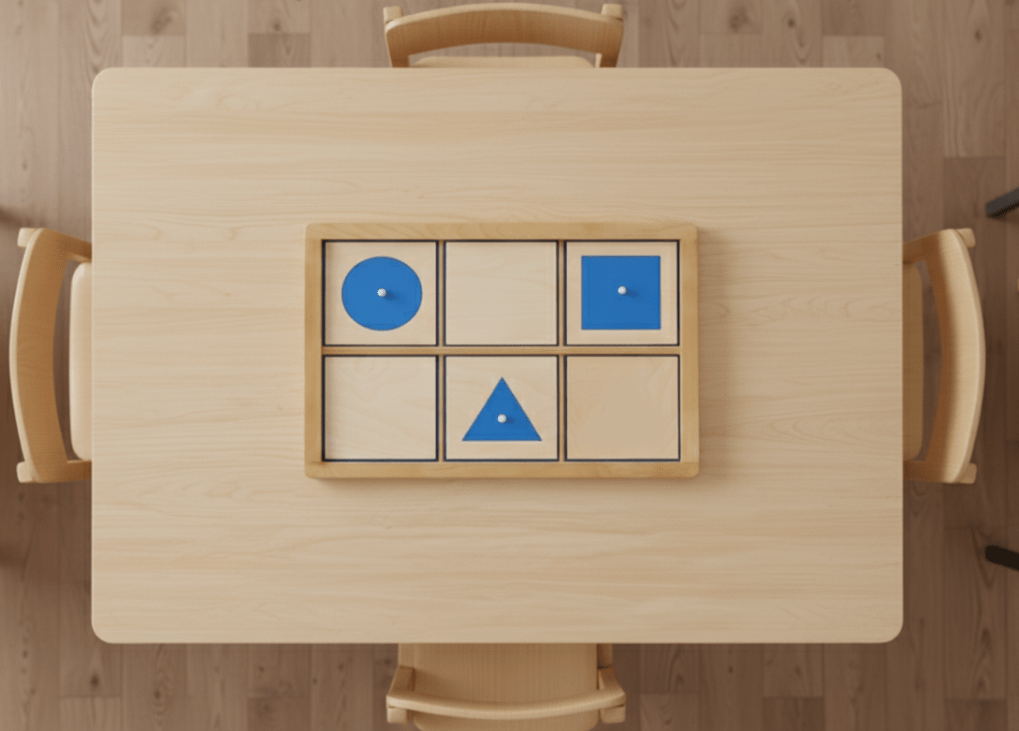
Traditionally, a “Demonstration Frame”, that sits on top of the cabinet, holds the Circle, Square, and an Equilateral Triangle. In some schools the order of the drawers differs from Early Childhood to Elementary environments. It is also important to note that there is no set of specific figures present in the cabinet. Certainly, there is always a Triangle Drawer, a Polygons drawer, a Rectangle drawer, and a Circle drawer. There is almost always a Quadrilateral drawer, but the sixth drawer can sometimes be Curved Figures, but a Miscellaneous Figures drawer is not uncommon!.
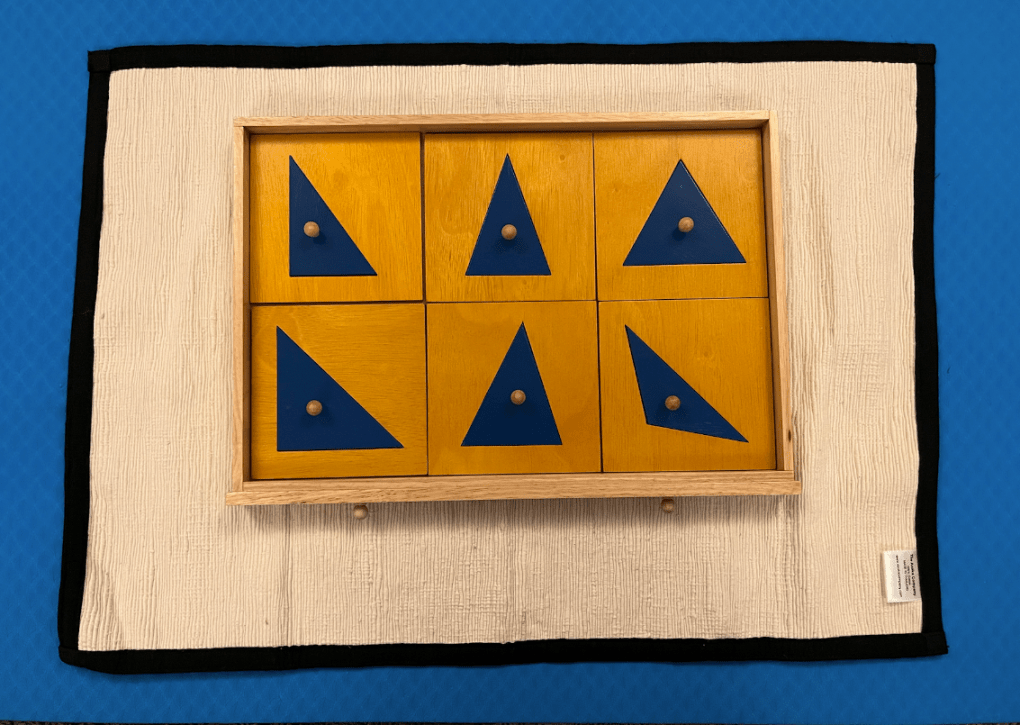
The first drawer displays triangles; acute-scalene, right scalene, obtuse-scalene, acute isosceles, right isosceles, and obtuse isosceles. The drawers present these shapes in two rows of three. How to order them? One suggestion would be the scalene, isosceles, and equilatreal across the top row to classify by sides the bottom row to show examples by angle. Right-angled in the first column, obtuse-angled in the middle column, acute-angled in the right. We put those after the right as they are both determined by their relationship to a 90 degree angle.
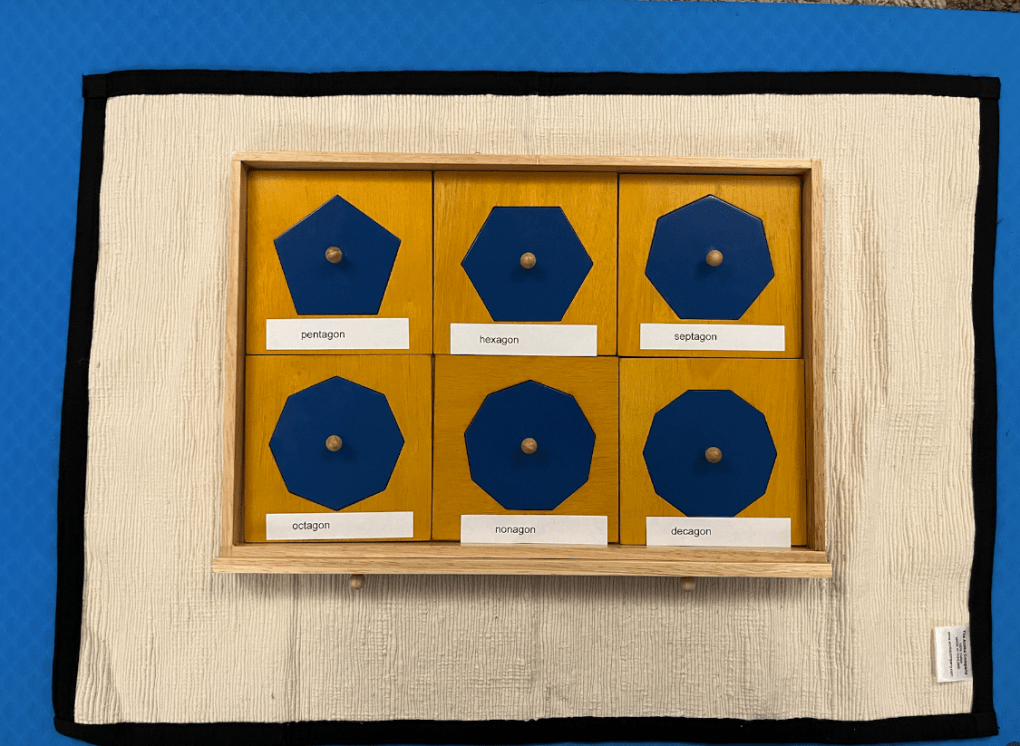
The second drawer displays quadrilaterals; trapezium (sometimes referred to as a common quadrilateral), parallelogram, trapezoid, and rhombus, The third drawer displays rectangles. There are six shapes total, five rectangles with gradually lengthening bases, and one square in the bottom right corner. The fourth drawer is a set of six regular polygons, and they are arranged by number of sides. The pentagon, hexagon, septagon make up the first row. Octagon, nonagon, and decagon round out the second row. The fifth drawer contains the circles. Again there are six, of different diameters starting in the top left (5cm) and ending in the bottom right (10cm). The 10cm circle matches the demonstration tray circle mentioned above. These drawers, with these figures, are common to every Geometric Cabinet.
A common, and desired sixth drawer contains curved figures. The oval and ellipse certainly, quatrefoils and a curviliinear triangle maybe. The curvilinear triangle can also be called a Rouleaux Triangle, named after Franz Reuleaux,a 19th-century German engineer who pioneered the study of machines for translating one type of motion into another, and who used Reuleaux triangles in his designs. As one could probably guess, the design itself predates him by centuries. Perhaps he had a better PR firm? The contents of some sixth drawers, as mentioned earlier, will use the drawer for miscellaneous figures, like the delta (kite) or a convex quadrilateral (boomerang).
The Cabinet is supported in both Early Childhood and Elementary classrooms with cards that match each figure. Typically the child starts with cards that are solid figures, then those with thick outlines, and finally a thin line outline. Labels for each figure can also be purchased or teacher-written. A companion material would ceratinly be the Constructive Triangles. It even has construct in its name, after all. It also represents a material that is presented not just in early childhood and lower elementary classrooms, but upper elementary as well.
When teacher-education is done right, a bond is formed between the presenter and the group of adult learners. If both parties are open, engaged, attentive, and respectful, the dialogues are more meaningful, the practice sessions are more energized, and it’s common for everyone to experience a “flow experience”, a concept developed by psychologist Mihaly Csikszentmihalyi, who studied how Montessori education can be structured to achieve it. I’ve found, in these decades of teacher-education, that the same is true for quality training course. “Where did the afternoon go?” This trusted relationship continues after the course is over, when these adult learners have questions once they are in their first months of teaching. If passion has been sparked and that flame nurtured, it remains. Last week, an email from Via, in Bandung, was in my inbox. What does it mean that the first stage of Montessori Development and the third stage are the same?
There are several similarities between children birth – 6 and 12 – 18. First, consider that the child in the First Plane is orienting themselves to this new world and environment in which they find themselves. They are learning new skills, certainly, but also observe them cognizant of being an individual, identifying themselves as part of a family, defining their relationship with their caregivers, and discovering their role. They are, at birth, nascent human beings. A teenager, on the cusp of puberty at the Third Plane of Development is also orienting themselves to a new world, the world and environment of adulthood. They are learning new skills, certainly, but they are now cognizant of becoming an adult, seeing their changing identification within their family, defining a new relationship with parents, thinking about who they are, what music they like, what books they enjoy, how they feel about larger societal issues. They are, at 12 years old, nascent adults.
How do we see these manifest in their behavior? There are similarities here as well, especially noticeable if you’ve had the opportunity to parent or teach children in both planes. Children in the first plane are highly egocentric; they are the center of their world. “What do I want right now?” “What do I need right now?” The child in the third plane is similarly motivated. “Everyone will be staring at me” “No one understands me”. Children in the first plane, especially in the second subplane, have a complex relationship with their caregivers. Observe the five-year old on the playground who runs to their father to get picked up only to immediately wiggle away to climb up the slide. Observe the 15 year old who wants to be independent. “Why can’t I go to the concert at the arena? You never let me do anything, I’m suffocating in this house!” but the next minute wants to curl up on the couch with mom or dad and watch old cartoons.
What’s fascinating to consider is that Dr. Montessori made these assertions well before science and medicine had access to brain studies. And yet, we know now that the first and third planes are both times of tremendous brain and neural growth. It’s common knowledge that from birth to six is the greatest growth, but less so that the second period of greatest growth is from twelve to eighteen years of age. First and Third represent growth. Second and Fourth represent consolidation.
The phrase “follow the child,” used in Montessori terms, is an axiom in the truest sense of the word: it is a truth that is self-evident. Upon these three words a pedagogy was built, and this system continues to expand well past the 100th anniversary of its inception. The fact that the world continues to catch up with a model which has been established and successful for more than a century serves as confirmation of its validity. As is the case with so many concepts we encounter in Montessori education, “follow the child” exists as a literal exhortation while at the same time revealing a deeper understanding of child development. Follow the child! As teachers (and good parents), we are exhorted to dictate less information and to allow more exploration. If the child shows an interest in the sensorial materials, the adult gives a lesson! When a child asks, “How do I add these if their denominators aren’t the same?,” the teacher presents the fraction circles. Follow the interest! Follow the question! Follow the child.
In a larger sense, “follow the child” is also a reflection of two overarching themes. First, the adult’s role is one of preparation and guidance and as a facilitator of the natural process that marks each child’s development. Second, a strong measure of independence is both a more humane approach to education and a proven component of a more profound level of learning.
Following is riskier than leading. For one thing, you have to watch where you step. For the teacher, this means adopting a level of comfort with trust, yes, but a trust that is buttressed by experience. For the child, being followed also involves trust: trusting that the adult, whether parent or teacher, is there to point things out along the way, provide support in case of a stumble, and allow him or her the space to walk.
As part of the celebration of Dr. Montessori’s birthday last summer, I was asked to participate in a global, daylong series of webinars, sponsored by Montessori-Haus Asia that spanned five time zones: China, Australia, Indonesia, Kazakhstan, and my house in Berwick, Maine, United States. As a nine hour event, it was meant to reach an international audience with the question, “One hundred fifty-five years after Maria Montessori’s birth, what is her legacy?” The word legacy seems, at least for me, to connote something that is finite. It was accomplished, in the past tense, and it’s been left to a school, a community, the world. That doesn’t really fit how I see Dr. Montessori’s work, and that formed the basis of my session. I see the Montessori method as alive and current. What she initiated as supposition, has become accepted conclusion.
I talked about the enormity of research, really over the last 50 years, be it educational or even neurological, that supports what Dr. Montessori somehow intuited over a century ago. They are too numerous to list here, but here are a few, just in the last 20 years, to highlight a small fraction. A study comparing Montessori and non-Montessori elementary students found Montessori children showed “superior outcomes in reading, math, executive function, and social problem-solving, suggesting the method supports both academic and social development.” (Lillard & Else-Quest (2006, Science) Research following Montessori middle school graduates into high school found they “performed as well or better than peers in math and science, indicating Montessori builds a strong foundation for later academic success”. (Dohrmann et al. 2007, Journal of Research in Childhood Education) An early difficulty interpreting Montessori studies was that it was conducted by Montessorians, which is of course, just bad science. There is much more rigor in these more recent studies. A randomized controlled trial of Montessori preschool programs showed “children had better academic outcomes, social understanding, and mastery orientation compared to peers in conventional classrooms.” (Lillard et al. (2017, Frontiers in Psychology) According to another study, using experience sampling (when subjects record their feelings and thoughts in real time), Montessori adolescents reported “higher levels of intrinsic motivation, interest, and engagement in learning than peers in traditional schools.” Rathunde & Csikszentmihalyi (2005, American Journal of Education) A similar study found Montessori students demonstrated “greater social cognition and positive peer interactions, suggesting the prepared environment fosters not only academic but also social-emotional growth.” (Lopata, Wallace, & Finn (2005, Journal of Research in Childhood Education). And last Spring, I read a fascinating study, reported in MontessoriPublic, titled, “Learning by Heart or with Heart: Brain Asymmetry Reflects Pedagogical Practices”, published in Brain Sciences (August 2023). This study used “neuroimaging to compare brain hemisphere asymmetry in schoolchildren educated in traditional versus Montessori settings.” On admissions tours at the Cornerstone School, I often joke, sort of, that, “Montessori kids are just wired differently”. I was right! Traditional‐schooled children showed “greater rightward asymmetry—linked with fixed, situation-specific memorization, but Montessori students showed left-dominant asymmetry, associated with semantic encoding and flexible conceptual connections.” As Montessori educators, we feel that our classrooms support not only in-depth learning, but also a deeply integrated experience that weaves knowledge in all curriculum areas into an integrated whole. A tapestry of understanding. It’s gratifying to know the concepts which Dr. Montessori felt were true, are in fact demonstrably true.
Masha spent the first few weeks in Tel Aviv in a bomb shelter. In an incredible act of bad timing, her long-awaited move to Israel coincided with the missile exchanges of mid-June. I had landed in Jakarta shortly after and we started an exchange of long emails that tended to run to the more thoughtful and philosophical. I met Masha in Chicago in the summer of 2023 when she was enrolled in a teacher-education program run by the Center for Jewish Montessori Teacher Education, a course I co-directed.. Two summers later and both of us were a long way from home. She wrote that she was curious as to how the Montessori schools in Southeast Asia were the same, how they differed. The question got me thinking in a broader sense, about how the spectrum of Montessori is interpreted across cultures.
I’ve written before regarding my experience of teaching adult learners in disparate parts of the Montessori world; Seoul, Savannah, Ghana, Charleston, Haiti, Baltimore, Shanghai, Buffalo, Florida, Chicago, Portsmouth, and Indonesia both decades ago and more recently last month, in Jakarta. The lens I would use was grounded in geography and setting and even school budgets; a Montessori classroom in an airplane hangar in Carrefour, Haiti, a $100,000 worth of materials with which to present in Shanghai. Another lens is theological. While most all of my work has been in secular programs, I’ve also been fortunate to teach against the backdrop of the world’s most populous religious traditions.
There’s a universal experience that I’ve felt with Montessori, especially now having been associated with Christian, Jewish, and Muslim communities of adult learners. A commonality among religions and the non-religious as to what inspires parents for their children, and what they hope a school environment will provide and nurture. Raising independent creative thinkers in nurturing classrooms that provide for the emotional and social development, not just academic achievement seems to be something that doesn’t care who you pray to. So things like parsha and davening, the Koran, the Torah, catechism, parables, learning Hebrew or using an Arabic moveable alphabet, those get woven into a tapestry of Montessori, quite easily. Like any course, there’s a difference in orthodoxy that’s reflected in the training, but there’s a baseline respect that you expect adult learners to share with the cohort, and that’s always been the case with my groups over the years. I don’t know as much about the scope of schools where these teachers will be guiding children. It’s clear that there’s a diversity in socio-economics, as there is everywhere, including the U.S., but in developing countries those lines are more jagged. I saw bead frames made of plywood and string instead of maple and gauge wire, but it’s a bead frame. Adds the same way. There’s a Buddhist concept that metaphors different religions as fingers pointing to the moon. Some people, even and in some cases especially the learned and “holy”, get caught up in whose finger is more devout, which finger is more accurately pointing to the transcendent and resplendent. Forgetting the moon entirely.
During a speech at the Montessori Teaching College in London, Mahatma Gandhi, referencing a speech by Dr. Montessori, famously said, “If there is to be peace in the world, it will begin with children.” Children tend to see the moon, so perhaps the universal appeal of Montessori to parents can play some role in resolving conflict. The subjunctive use of the word “if” has always interested me. Gandhi was hopeful, but from experience a realist as well. Masha writes that the ceasefire has allowed her more time up and out instead of down and in. She’s looking for work, planning on contacting Montessori schools, applying for a position. Masha is both kind-hearted and open-minded, curious, and growth-centered. She’ll be fine, great in fact. I hope she keeps writing.
First, remember that sambal is included with every meal. Lunch and dinner bento boxes will always have a snowball of rice, wrapped in twisted paper. “It’ wouldn’t ‘s not a meal if it doesn’t have rice”, one dear friend informed me years ago during my first trips to Indonesia, and I’m sure her opinion has not changed. There will be beef or chicken, tempeh or tofu, cucumbers raw or greens cooked, but do investigate the sambol first. This relish of hot pepper and oils comes in varying degrees of heat, the most mild being “oh wow, (running nose sniff), that is… (sweating forehead) powerful” and progressing to “I think just a bit on the tip of my tongue will be good for the day”. At no point should you look around at your fellow diners and note how all of them have dumped the entirety of their sambol, heaping tablespoons of magma, onto to their food without concern or comment. Do not feel pressure to emulate.
So yes, there is heat in this beautiful country. Heat in the tropical day and reflected evening, heat in the bright batik colors of shirts, dresses and hijabs, heat in the sambol and black pepper sauce, but also in a collective passion for Montessori education, still in a nascent stage for Lower Elementary. Consider this a note from abroad, saying that Montessori is alive and well, and well, growing in interest and scope in Java, Sumatra, Surabaya. After five virtual webinars in the Spring, concentrating on philosophy and methods, it was an honor to participate in the first comprehensive teacher-education program for Montessori Lower Elementary in Indonesia, and the first to run for two consecutive weeks, This cohort of twenty plus adult learners, working through Montessori Haus-Asia, spent a week each learning and practicing Arithmetic and Geometry. It’s easy to say that they were among the most hardest-working and practicing groups I’ve engaged with as a teacher-educator, a role I’ve played with TEPs since 1992. I often tell groups that a successful training session is really a partnership; a high level of positive energy that both presenter and adult learners bring to the process, is crucial to its result. These past two weeks were testament to that supposition, and very much looking forward to more to come in 2026. Bring on the sambol.