
Alfred North Whitehead was an English mathematician and philosopher who also wrote frequently and eloquently about education. He was a contemporary of Maria Montessori (though I’ve yet to find any record of them actually meeting) and it’s instructive to examine how their thoughts on pedagogy overlap. Whitehead saw the learning process as having three components, which he labeled romance, precision, and generalization. In the romance stage, the child is first presented with a new concept and enjoys the emotion of discovery. According to Whitehead, the child is “becoming used to curious thoughts, of shaping questions, of seeking for answers, of devising new experiences, and of noticing what happens as the result of new ventures.” Picture a child’s first experience at a beach strewn with shells of various shapes, sizes, texture, and color. They are given to the visceral excitement of the moment as they explore the myriad of what is before them. If this energy is acknowledged and supported, Whitehead asserts that a second desire will arise, one that craves deeper, more precise information, to answer the very questions that the stage of romance engendered. The child, home from the beach, gets out shell identification books and the “S” encyclopedia (Googles it?) and excitedly learns the types, biology, and nomenclature of shellfish. Whitehead made a point of noting that traditional education puts an emphasis just on this second stage of precision; the facts, the specifics, the right and wrong. But without the more general, the broader view that comes from the romance stage, he argued, the facts are barren and nebulous, unattached to any larger context, and quickly forgotten. The third stage of the learning process, is that of generalization and synthesis. It is a stage that leads the child further, allowing the integration of this new-found information into creative ideation and a cogent “whole”. It also, quite elegantly, leads the child back to the first stage of romance, of discovery, but with the addition of this gained wealth of knowledge. Subsequent excursions to the beach equal the excited discovery of the first trip, but the experience is now imbued with a greater sense of wisdom, as the specific is now seamlessly integrated with the whole.
Tag: writing
mostly they come back
Yesterday we had our annual Back-to-School gathering. Depending on where you read about it – in a newsletter, on the calendar, in an email, online – it’s either named a Potluck, Barbecue, Picnic, or Cookout. After years of trying to land on one name, I’ve decided to just lean into it and call it all four names, separated by a slash. Anyway, this back-to-school event (a fifth name!!) . has become an unofficial alumni gathering. Sophie came for a visit. Chris, matriculating at Loyola University, stopped in as well. Even during the year, it’s quite common to find an alumni stopping by and getting involved in a game of Southern Dodgeball, and with five alumni now Toddler parents, the scroll continues. In short, “once a Cornerstone kid, always a Cornerstone kid”.
One of the aspects of being a teacher is the continuity of task that occurs as children move through your classroom year in and year out. For a 6th grade Social Studies teacher at a large institution, it must be somewhat numbing after eight, ten years to see a group of 25 children through your Day 1 Period Four class, largely teaching the same lessons from the the same textbook. On bad days, I would imagine it feels a bit like being preserved in amber while the world moves on and forward in the lives of students you barely got to know into lives you’ll not be privy to following. Do these students feel compelled to return, often, to those schools? To those classrooms? To those teachers?
Our Montessori schools are a community of all of our families, but most acutely it is a family of children, guided by adults that are with them for well over 3,000 hours in any one level (Primary, Lower El, etc…). By graduation, a child may have spent virtually the first 12 years of life within the relatively small and cozy confines of their Montessori school. They toddled down those hallways holding the hand of an older sibling. With a friend, they sought out examples of spheres and cones from each classroom. As a young emerging reader they had a Reading Mentor in the Early Adolescent Class (a Big Kid!); six years later, they WERE the Reading Mentor. Performances ranging from mouthing the words in a group choir, squinting at the bright lights and trying to find Mom and Dad in the audience to taking a lead role in a Spring Musical were all experienced on the same stage. Sleeping bags were set up in the gym, in his or her classroom, on the soccer field, at a campground, with classmates who doubled as pseudo-siblings. As your child travels through their school, from upstairs classrooms to downstairs classrooms and finally back up again, it becomes much more than their school. It becomes another home.
Fall often brings a Parent Conference Day. For many eighth- graders and their parents, the day is tinged with melancholy. Is it any wonder that the excitement of entering your last year and the search for your future is balanced with a sense of loss for what you will soon be leaving behind? We temper those emotions, and they can be just as acute for the adults, with the knowledge that these young adults will always be “Our Kids”. Mostly they come back.
valorization
The thank-you card was tucked in the striped bag, the words more valuable than the gift. “Thanks for making me feel confident every time I see the farm (even though I might not have the greenest of thumbs), and making me think, ‘there’s a little bit of me in that garden, in that shed. Thanks for making me feel that I helped.” A Montessori environment is carefully prepared to allow a child to work to their potential, and successfully move through the planes of development from birth to adulthood. During the first two six-year planes (Toddler through Upper Elementary), Montessori used the term “normalization” to describe the child’s acquisition of developmental characteristics such as profound spontaneous concentration, an attachment to reality, the power to choose work independently, and a love of silence, order, and work.
During the third plane of development, however, Montessori spoke of a new goal for this new, older child. “Valorization” describes the process an adolescent must go through in order to integrate a mature identity and the sense of being able to succeed in life by his/her own efforts, or, in other words, become an adult. This manifests itself in qualities such as selflessness (believe it or not), confidence, dignity, initiative, independence, helpfulness, good judgement, and the ability to work with others.
The prepared environment of the Early Adolescent class reflects this goal, one of which is through a component of the curriculum that Montessori named, “Occupations”. These “Junior Classes” operate a series of micro-economies, student-run small businesses with adult guidance. These economies take the form of products, services, workshops, etc… The wider school community supports these efforts through their patronage, while providing a critical learning opportunity for this age- group. The third-plane student learns that they are capable of great things. That they can, through their own efforts and in concert with peers, accomplish a real task, complete a real job, prepare and serve a hot lunch to a 6 year-old (and clean the kitchen afterward), plant and harvest a crop, build a raised bed. They learn what it means to make a good judgement, the consequences of making a bad one, and the restitution or redress that those choices require of them.
The process of valorization is not limited to the farm or the kitchen. The ability to assemble a raised bed parallels the confidence needed to graph a linear equation, to take on a role in Shakespeare, to present yourself at an interview, to construct your own future.
Montessori students going out
We hear it all the time. Most any time Montessori teachers are out on a field trip, “going out” as Dr. Montessori termed it, invariably a docent, or tour guide, or waiter will comment on the deportment of our students. A few years back, I was with the Juniors, early adolescents, touring the Smithsonian Museum of American History in Washington, DC, and a group of restoration experts working on an early flag. We saw their nearly-completed work, the Star-Spangled Banner repaired and cleaned, laid out behind smoky glass. We snaked through the display that included many supporting displays and historic pieces. As the last of us moved past the docent, she called the teachers back. “Excuse me, but where is this group from”? We told her who we were. “Well, I have to tell you, I have NEVER in all my years, had a school group as well-behaved and engaged as what I just saw from your group, and I’ve been doing this for a l-o-n-g time.” I relate this story not as news, but as an example of the kind of response Montessori students elicit when they’re out and about. But it was a later occurrence, in the same museum, where the nascent adults showed not just an interest in content, but in humanity.
A docent at an exhibit on Working Women spent 10 minutes or so giving further information on the displays that surrounded us. As the class thanked her and moved away, the Junior eighth-grade girls paused to thank her personally. She was obviously very pleased by this. But the next questions almost moved her to tears. Our students wanted to know: “How did she, personally, get her start at the Smithsonian? How long had she been working here? It must be a wonderful job…” As the woman proudly displayed her Forty Years of Service Pin to an awed group of teenagers she smiled a little sheepishly and said that she almost didn’t make it due to a broken hip. “Well, I hope you’re able to keep on doing this for a long, long time.” Our teens congratulated her even more heartily and as they were strolling away wished her many more wonderful years at the museum. The exchange was longer than I am relating, and was heartfelt. We have no doubt that in all her wonderful years, this sincere, interested group must have made quite an impression. showing an interest in who she was, not just the material she was covering. This deeper understanding of an experience, this comprehension of the whole, this awareness of the connection to others, this empathy as an expression of full interest, is one of the many intangibles we are gifted to observe. We hear it all the time. It never gets old.
can kindness be taught
One positive aspect of the social media explosion is the ease of staying in touch it affords. Alumni and their parents share their post-Cornerstone experiences more freely, because it’s just a click/send away. For some of our past students, Cornerstone represents twelve years of their life, building a sense of ownership and home that is not forgotten by a mere change of address. In short, we get letters. This came in from a parent, a forwarding of an email they had received from a high school teacher of a Cornerstone graduate: “I just wanted to let you know your son ended the semester with one of the only A+ with Honors I have ever given. On that note, while I know you know how talented he is, I want to throw in my 2 cents that he should take as many AP classes as possible next year. I have tried hard to keep him challenged in my class, but he is so far beyond other students that I don’t think regular classes are the place for him.” Truthfully, this is not uncommon for our graduates, but the parent highlighted the second part of the teacher’s email as being more meaningful: “The other thing I think is great about your son is that even though he finishes his work easily he helps other students. There is one student in particular that sits next to him and she struggles every day. With the patience of a teacher he helps her ALL class. Sometimes I think she is going to wear on his patience but he just gently answers her questions.“
Can kindness, in fact, be taught? As Montessorians, we would answer, “No more than we ‘teach’ geography or arithmetic or science”. Rather, a Montessori school creates an environment, carves a space, maintains a culture that allows a natural process to take place. And while it isn’t quantified on any conference report, the grace and courtesy aspect of our curriculum is an integral component of the fabric of our classrooms. This serves, strongly, as the tapestry on which our lessons are woven. It is so present in fact, that a consistent comment I hear from prospective parents, even after a mere 20-minute observation, is the kindness they witness amongst our students, regardless of class level. Last week, after an especially moving observation, a parent sat with me in the hallway outside of the Junior Class, asking me the how’s and why’s of our school. They enthusiastically embraced the peacefulness and kindness they saw that morning. “Does that happen every day?”, she asked, perhaps a little suspicious. At that moment, Quetzal and Nicholas walked by, hand-in-hand. “Yeh, I said, “Pretty much.”
fast-forward, please
Dad – I’m making a little baby box about Lyra’s birthday with some of her hospital stuff. I wanna include a paragraph from you about remembering when she was born or when you first met her. Skip the trauma part.
There’s a picture of a baby on the kitchen windowsill at my daughter’s house. It’s small and round and cropped in an outline of Lyra’s six-month-old face. Her eyes are scrunched closed. The photograph itself is attached to a popsicle stick, and this allows it to stand in a clay pot, sharing space with an aloe plant. It is just one of a couple dozen shots of Lyra, spanning her first year of life, still to be found, now over two years later, in odd spaces around their house. Lyra looking surprised, Lyra mid-laugh, Lyra in sunglasses. Lyra with a small teddy-bear bandage holding tiny oxygen tubes as small as new stems of grass, onto her blush cheek. There are no photos of the feeding tube, none showing the nickel-sized electrodes dominating her small chest, none taken at the NICU.
All of those photos, all of those Lyra-adorned cupcakes, had once been frosted and laid out on a fold-up table along with the other party food, the pizza and cookies and cake. The birthday cake had a single candle that day, marking a year, a tally of emotions that come with a first child, for Amarinda and Brendan, and a first grandchild for Sandi and me. Gathered that bright and lush September Saturday in Maine, which was bravely holding onto the last of that summer’s warmth, were Lyra’s uncles and aunts, cousins and friends, all there to celebrate an infant turned one. She sat on a dozen different laps, sampled most of the food, and was generally unaware of the fuss and festivities unfurling around her. Every first birthday party is for the adults after all, to see each other, to catch up, the how’s the new job and I can’t believe he’s almost a teenager conversations, and the common question of, “can it already have been a year since Lyra was born?” And if there were thoughts of a year prior, when she arrived eight weeks ahead of expectation, well, those past emotions had healed and changed and grown right along with her.
If we had known, those first fraught hours and days of her life, that in twelve short months we’d be eating Lyra-cupcakes and helping her open the many birthday presents she received from us, her devoted legion, it would’ve been less scary. We could collectively have said, “Oh, THAT’s how this works out.” But life doesn’t work that way, does it. The Buddhists tell us to stay in the moment. To be mindful and dwell in the present. Be now. But in some cases, being able to glimpse just a whisper ahead, would be good for the soul.
Dedicated to Flor, who says I shouldn’t just write about Montessori.
the constructor
Dr. Montessori often used the word, “costruire”, the translation from the Italian being “to build, create, to construct”. Before children can become Greeks (working abstractly), they must first be Egyptians (use their hands). One could write a treatise (or two!) on the myriad of ways a Montessori prepared environment provides opportunities for a child to construct, both physically, cognitively, and even as a metaphor for emotional and social growth. Specific to a manipulative material, the Geometric Cabinet can serve as an excellent model for the concept of construction.
The Geometric Cabinet is one of the more important and versatile geometry materials we have in our Montessori classroom. It is, or should be, present in every Early Childhood and Lower Elementary classroom, but it is also used (more likely borrowed) in many Upper Elementary environments as well. It is a beautiful material to display. The large wooden cabinet with six drawers brings attention to itself and adds to the impressive array of our Montessori environments.
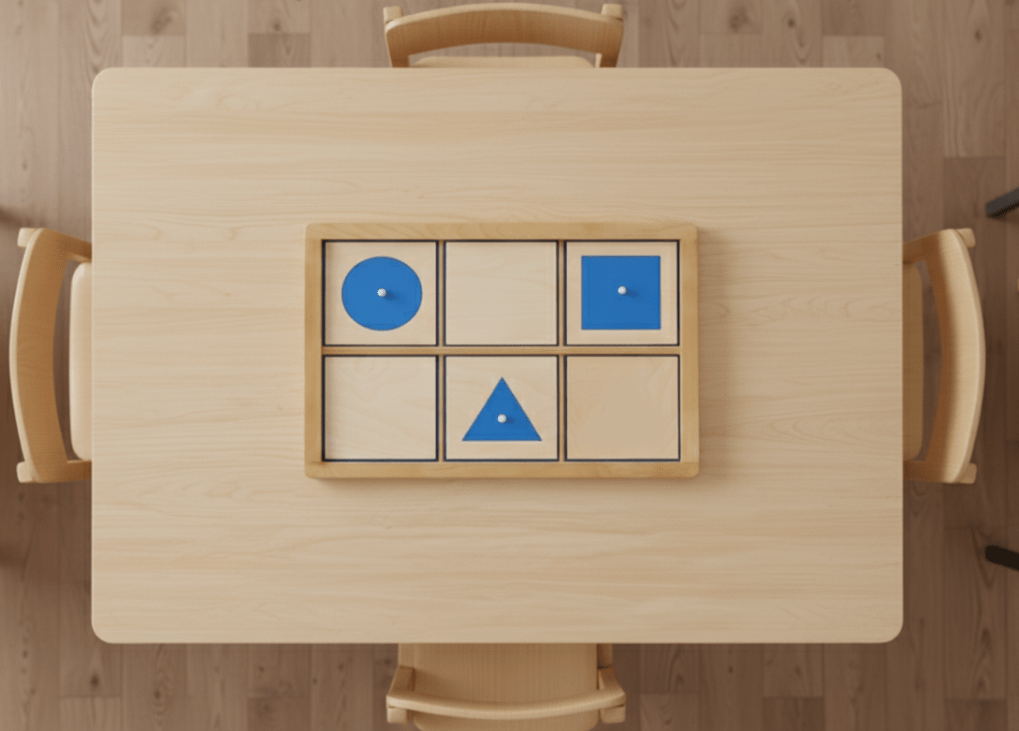
Traditionally, a “Demonstration Frame”, that sits on top of the cabinet, holds the Circle, Square, and an Equilateral Triangle. In some schools the order of the drawers differs from Early Childhood to Elementary environments. It is also important to note that there is no set of specific figures present in the cabinet. Certainly, there is always a Triangle Drawer, a Polygons drawer, a Rectangle drawer, and a Circle drawer. There is almost always a Quadrilateral drawer, but the sixth drawer can sometimes be Curved Figures, but a Miscellaneous Figures drawer is not uncommon!.
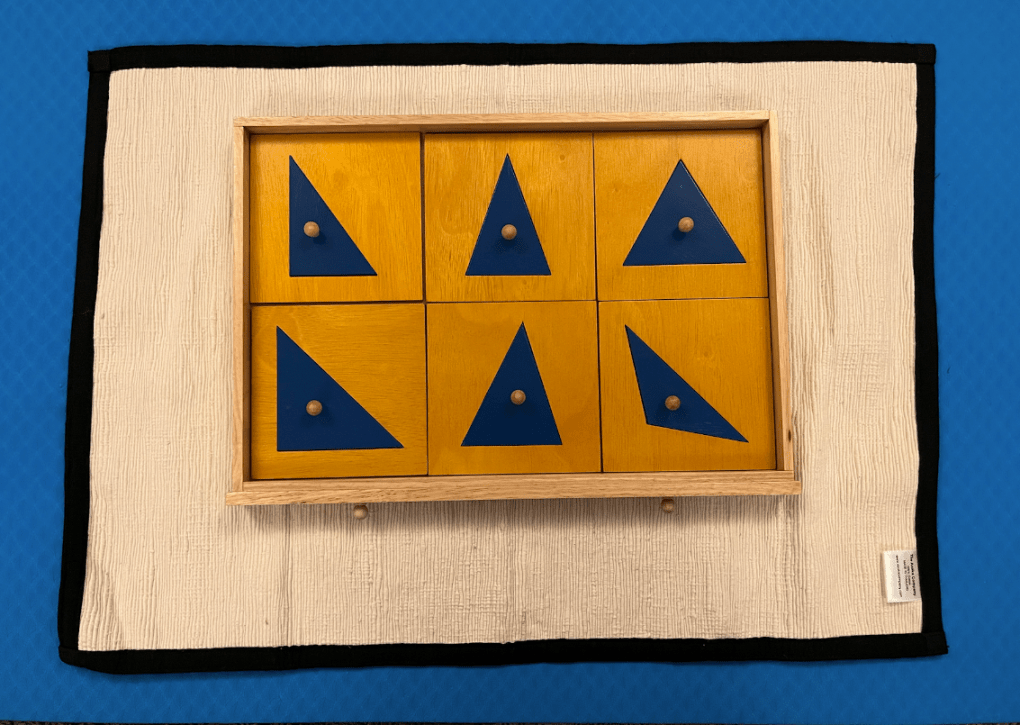
The first drawer displays triangles; acute-scalene, right scalene, obtuse-scalene, acute isosceles, right isosceles, and obtuse isosceles. The drawers present these shapes in two rows of three. How to order them? One suggestion would be the scalene, isosceles, and equilatreal across the top row to classify by sides the bottom row to show examples by angle. Right-angled in the first column, obtuse-angled in the middle column, acute-angled in the right. We put those after the right as they are both determined by their relationship to a 90 degree angle.
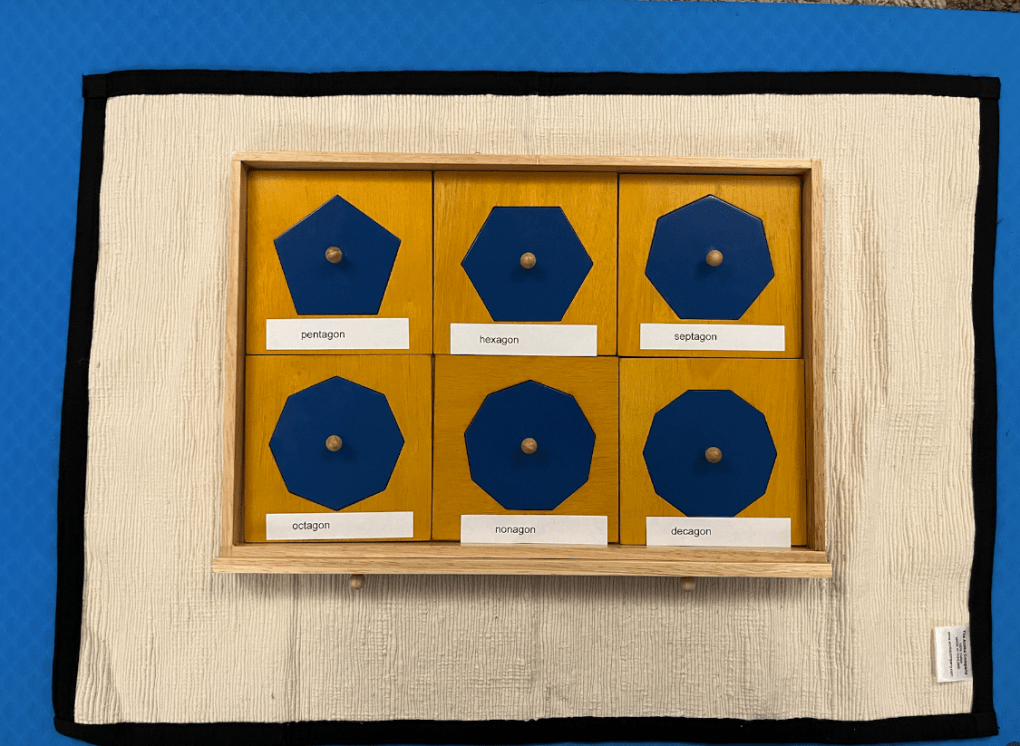
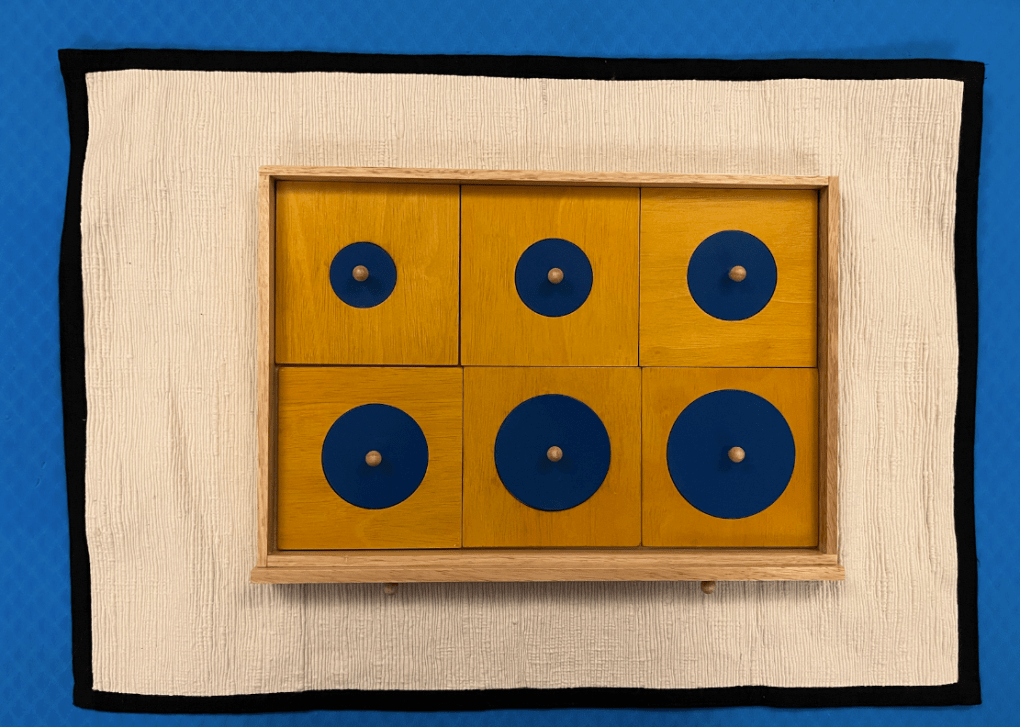
The second drawer displays quadrilaterals; trapezium (sometimes referred to as a common quadrilateral), parallelogram, trapezoid, and rhombus, The third drawer displays rectangles. There are six shapes total, five rectangles with gradually lengthening bases, and one square in the bottom right corner. The fourth drawer is a set of six regular polygons, and they are arranged by number of sides. The pentagon, hexagon, septagon make up the first row. Octagon, nonagon, and decagon round out the second row. The fifth drawer contains the circles. Again there are six, of different diameters starting in the top left (5cm) and ending in the bottom right (10cm). The 10cm circle matches the demonstration tray circle mentioned above. These drawers, with these figures, are common to every Geometric Cabinet.
A common, and desired sixth drawer contains curved figures. The oval and ellipse certainly, quatrefoils and a curviliinear triangle maybe. The curvilinear triangle can also be called a Rouleaux Triangle, named after Franz Reuleaux,a 19th-century German engineer who pioneered the study of machines for translating one type of motion into another, and who used Reuleaux triangles in his designs. As one could probably guess, the design itself predates him by centuries. Perhaps he had a better PR firm? The contents of some sixth drawers, as mentioned earlier, will use the drawer for miscellaneous figures, like the delta (kite) or a convex quadrilateral (boomerang).
The Cabinet is supported in both Early Childhood and Elementary classrooms with cards that match each figure. Typically the child starts with cards that are solid figures, then those with thick outlines, and finally a thin line outline. Labels for each figure can also be purchased or teacher-written. A companion material would ceratinly be the Constructive Triangles. It even has construct in its name, after all. It also represents a material that is presented not just in early childhood and lower elementary classrooms, but upper elementary as well.
fingers pointing at the moon
Masha spent the first few weeks in Tel Aviv in a bomb shelter. In an incredible act of bad timing, her long-awaited move to Israel coincided with the missile exchanges of mid-June. I had landed in Jakarta shortly after and we started an exchange of long emails that tended to run to the more thoughtful and philosophical. I met Masha in Chicago in the summer of 2023 when she was enrolled in a teacher-education program run by the Center for Jewish Montessori Teacher Education, a course I co-directed.. Two summers later and both of us were a long way from home. She wrote that she was curious as to how the Montessori schools in Southeast Asia were the same, how they differed. The question got me thinking in a broader sense, about how the spectrum of Montessori is interpreted across cultures.
I’ve written before regarding my experience of teaching adult learners in disparate parts of the Montessori world; Seoul, Savannah, Ghana, Charleston, Haiti, Baltimore, Shanghai, Buffalo, Florida, Chicago, Portsmouth, and Indonesia both decades ago and more recently last month, in Jakarta. The lens I would use was grounded in geography and setting and even school budgets; a Montessori classroom in an airplane hangar in Carrefour, Haiti, a $100,000 worth of materials with which to present in Shanghai. Another lens is theological. While most all of my work has been in secular programs, I’ve also been fortunate to teach against the backdrop of the world’s most populous religious traditions.
There’s a universal experience that I’ve felt with Montessori, especially now having been associated with Christian, Jewish, and Muslim communities of adult learners. A commonality among religions and the non-religious as to what inspires parents for their children, and what they hope a school environment will provide and nurture. Raising independent creative thinkers in nurturing classrooms that provide for the emotional and social development, not just academic achievement seems to be something that doesn’t care who you pray to. So things like parsha and davening, the Koran, the Torah, catechism, parables, learning Hebrew or using an Arabic moveable alphabet, those get woven into a tapestry of Montessori, quite easily. Like any course, there’s a difference in orthodoxy that’s reflected in the training, but there’s a baseline respect that you expect adult learners to share with the cohort, and that’s always been the case with my groups over the years. I don’t know as much about the scope of schools where these teachers will be guiding children. It’s clear that there’s a diversity in socio-economics, as there is everywhere, including the U.S., but in developing countries those lines are more jagged. I saw bead frames made of plywood and string instead of maple and gauge wire, but it’s a bead frame. Adds the same way. There’s a Buddhist concept that metaphors different religions as fingers pointing to the moon. Some people, even and in some cases especially the learned and “holy”, get caught up in whose finger is more devout, which finger is more accurately pointing to the transcendent and resplendent. Forgetting the moon entirely.
During a speech at the Montessori Teaching College in London, Mahatma Gandhi, referencing a speech by Dr. Montessori, famously said, “If there is to be peace in the world, it will begin with children.” Children tend to see the moon, so perhaps the universal appeal of Montessori to parents can play some role in resolving conflict. The subjunctive use of the word “if” has always interested me. Gandhi was hopeful, but from experience a realist as well. Masha writes that the ceasefire has allowed her more time up and out instead of down and in. She’s looking for work, planning on contacting Montessori schools, applying for a position. Masha is both kind-hearted and open-minded, curious, and growth-centered. She’ll be fine, great in fact. I hope she keeps writing.

